Redux is a predictable state container for managing application data through a store, dispatched actions, and reducers. It suits complex or shared state, but classic Redux carries substantial boilerplate; Redux Toolkit (RTK) reduces that cost. section 8.0 section 8.5
The core architecture organizes state management around a repeatable cycle:
- Keep application state in a store divided into related slices. section 8.5.1
- Dispatch actions from action creators in response to user interaction. section 8.5.1
- Pass actions and previous state to reducers, then update the store with the reduced state. section 8.5.1
- Read state with useSelector and update it with useDispatch through Redux’s built-in provider. section 8.5.1
A data slice
A data slice can group related reducers, actions, and action creators. In RTK, defining an increment reducer also produces an increment() action creator, compressing several classic Redux definitions into one implementation. section 8.5.1
Figure 8.15 The simplified Redux cycle. State is kept in the store. The state defines how the application is rendered. When the user interacts with the application, actions are dispatched, and the store sends them to the relevant reducer along with the old state. The newly reduced state is updated in the store and sent back to the application, and the cycle repeats.
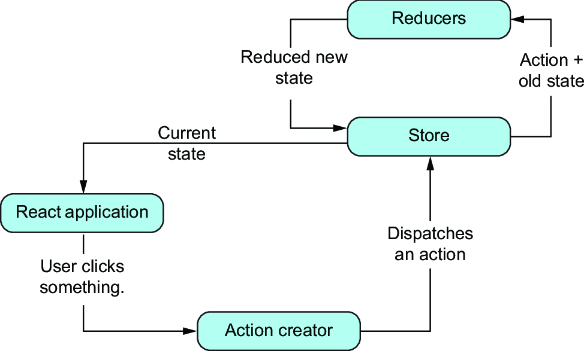
Trace the Redux cycle from rendered state through dispatched actions and reducers back to updated store state. section 8.5.1

