Referential transparency makes an expression dependable: replace it with the value it produces, and the program still means the same thing. A referentially transparent function returns a consistent result for the same input instead of depending on changing external state. That makes program logic easier to follow as a chain from input to output. section 1.2
Replace a call with its result
An average function can be understood by substituting its intermediate values. Given `[80, 90, 100]`, `average(input)` becomes `divide(270, 3)`, then `90`. This works because the helper functions compute from their arguments, making the expression equationally correct rather than dependent on hidden state. section 1.2
Contrast that with a counter stored outside a function. `increment()` that performs `++counter` can return a different value on each call because another part of the program may change `counter`. Refactor the changing value into an argument instead: `const increment = counter => counter + 1`. Now the result is determined by the supplied counter, and the caller decides what to do with it. section 1.2
Figure 1.2. Comparison of working with imperative and functional versions of increment. The result of the imperative version is unpredictable and can be inconsistent because the external counter variable may change at any time, compromising the result of successive invocations of the function. The referentially transparent functional version is always equationally correct and leaves no room for errors.
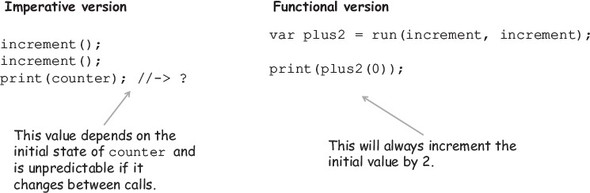
Compare the stateful increment function with a version that receives its value explicitly. The contrast shows why external mutation prevents reliable substitution. section 1.2
Referential transparency supports practical functional programming habits:
- Break work into small functions with clear inputs and outputs, then combine compatible results through composition. section 1.3
- Write specifications in terms of definite inputs and expected outputs, which automated property-based tests can exercise repeatedly. section 6.4
- Allow safe algebraic rewrites of pure `map` and `filter` operations, enabling Lodash shortcut fusion to reduce intermediate structures. section 7.2
Why it matters for testing and optimization
A property can state that `computeAverageGrade(grades)` must produce `'A'` for grades in the specified range. Because a referentially transparent function has clear inputs and consistent results, JSCheck can generate many cases against that property. The same predictability lets a sequence such as `compose(map(f), map(g))` be rewritten as `map(compose(f, g))` without changing its meaning. section 6.4 section 7.2
The key takeaway is simple: keep calculation separate from changing the outside world. When a function receives the data it needs and returns a value, you can reason about it locally, test it with generated inputs, compose it with other functions, and safely transform some operation chains. section 1.2 section 7.2








