ReFeX (Recursive Feature eXtraction) automates structural feature engineering while retaining interpretable, deterministic representations. It provides a practical middle ground between manually designed graph metrics and black-box representation learning. section 10.3 section 10.3.2
A ReFeX pipeline progressively expands each node’s structural description:
- Extract local features such as node degree. section 10.3.1
- Compute egonet features, including node counts, internal edges, and edges reaching outside the egonet. section 10.3.1
- Aggregate neighboring feature values repeatedly with operators such as SUM and MEAN. section 10.3.1
- Prune redundant features after recursive iterations to control complexity and improve selection. section 10.3.2
Manual calculation for node A
For node A, degree is 6, the egonet contains 7 nodes and 7 internal edges, the first neighbor-degree sum is 17, and the second aggregated sum is 69. MEAN produces approximately 2.83 and 11.5 at the corresponding iterations. section 10.3.1
Figure 10.8 ReFeX converts each node into a vector representing the node’s topological feature at different scales [8].
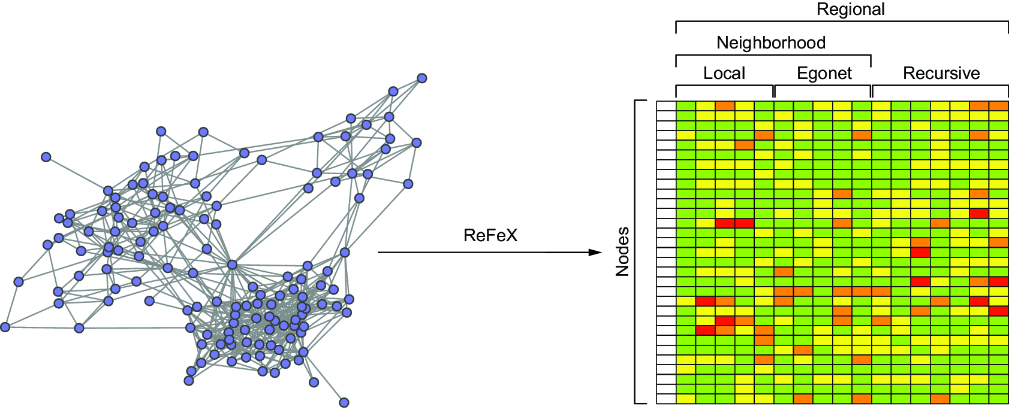
Visualizes how ReFeX converts each node into a vector containing topological features at multiple structural scales. section 10.3
