Reflected intelligence uses feedback from user interactions to continually improve search relevance. It helps search results adapt to what users do, rather than remaining static. section 1.3.1 section 4.2.1
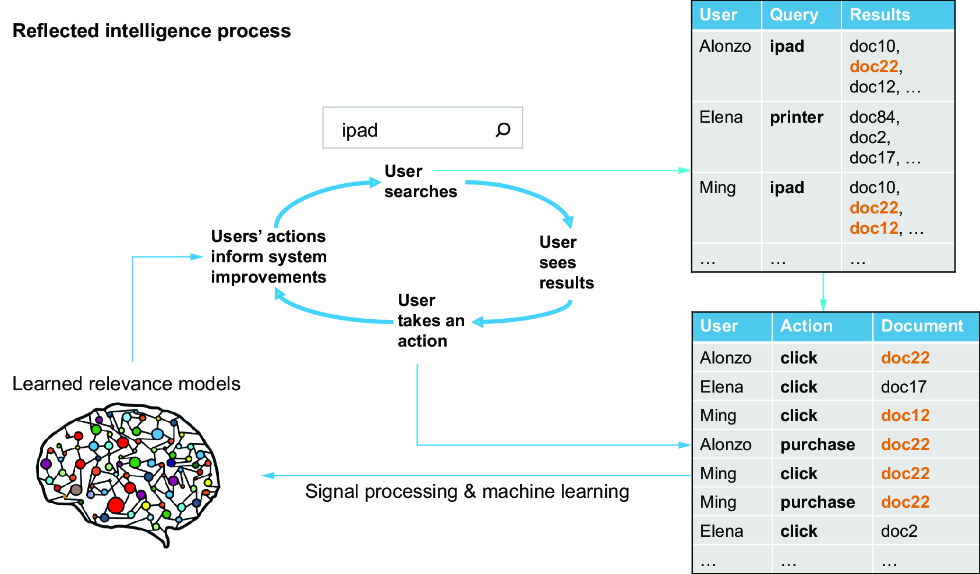
The process starts with a query and the results shown to a user. The search engine records those results, then logs actions such as clicks or purchases. Aggregated signals from many users feed machine-learning models; the learned models are deployed back into search to improve later results, and the loop repeats. section 4.2.1
Learned models can boost popular results for particular queries, personalize results, or identify attributes that matter across users. They can also learn query patterns such as misspellings, phrases, and synonyms. section 4.2.1
A query becomes a learning signal
A user searches for “ipad,” sees a result for doc22, clicks it, and purchases the product. Those actions join other users’ signals and can inform relevance models for future searches. section 4.2.1
Figure 4.2 The reflected intelligence process. A user issues a query, sees results, and takes a set of actions. Those actions (signals) are then processed to create learned relevance models that improve future searches.
Follow the cycle from a user query and actions to learned models and improved future searches. section 4.2.1
