Reflection redirects a propagating electromagnetic wave when it encounters a surface or boundary. Instead of passing through, the wave bounces off the surface, affecting wireless signal behavior. section 18.1.2
In wireless LAN design, reflection is identified by these practical effects:
- Metal surfaces strongly reflect radio waves, so signals may bounce rather than penetrate. section 18.1.2
- Elevators commonly have poor wireless reception because their metal surfaces reflect the signal and allow little penetration. section 18.1.2
- Reflection is one environmental factor, alongside free-space path loss, diffraction, and scattering, that influences wireless coverage. section 18.1.1
Elevator reception
A wireless signal approaching a metal elevator may bounce off the elevator walls instead of entering effectively, producing weak reception inside. section 18.1.2
Figure 18.4 Phenomena affecting the behavior of electromagnetic waves include absorption by a medium, reflection off surfaces, refraction (bending) as waves pass through a medium, diffraction around obstacles, and scattering from irregularities.
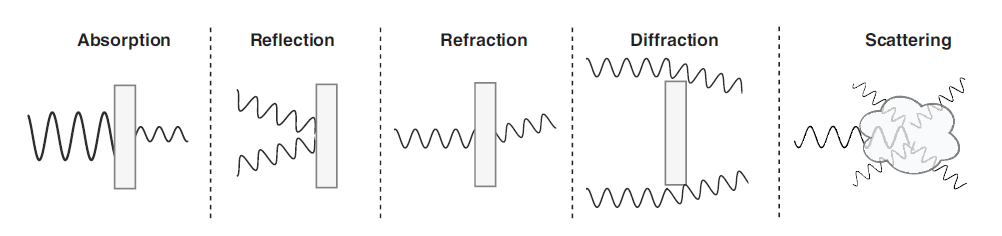
Compare reflection with absorption, refraction, diffraction, and scattering as electromagnetic-wave behaviors affecting wireless LAN design. section 18.1.2
