Reflection about the mean is the Grover iteration step that reflects a quantum state about the mean state, the uniform superposition of the search-space basis states. It preserves the component parallel to \(\ket{\mathrm{mean}}\) and reverses the sign of the orthogonal component. After a phase oracle marks solution amplitudes by a sign flip, this reflection shifts the state toward \(\ket{\mathrm{solutions}}\). section 7.2.1 section 7.2.2
For reflection about an arbitrary fixed state \(\ket{\psi}\), decompose an input \(\ket{\phi}\) into its parallel and orthogonal parts. The reflection operator is \(\ket{\psi}\bra{\psi}-(I-\ket{\psi}\bra{\psi})\): the projector \(\ket{\psi}\bra{\psi}\) keeps the parallel part, while the remaining orthogonal part is multiplied by \(-1\). A practical construction starts from a unitary \(V\) that prepares the target reflection axis from a simple state, such as \(V\ket{0}=\ket{\psi}\). section 7.2.1
Within Grover’s search, use the operation as part of a controlled iteration:
- Prepare \(\ket{\mathrm{mean}}\), the superposition over candidate basis states. section 7.2.2
- Apply the phase oracle, which negates the solution component while leaving non-solution basis states unchanged. section 7.2.1
- Apply reflection about the mean immediately afterward; the two reflections combine into a counterclockwise rotation by \(2\theta\). section 7.2.2
- Measure after the selected number of iterations and verify the returned candidate, since the search remains probabilistic. section 7.2.2
Figure 7.8 Each iteration of Grover’s algorithm rotates the state of the system in counterclockwise direction by the angle \(2\theta\). Up to a certain point, each iteration rotates the state closer to the vertical axis, the \(\ket{\textrm{solutions}}\) state. The closer the state is to \(\ket{\textrm{solutions}}\), the higher the probability of the measurement yielding a correct answer is. If you apply too many iterations (in this case, three or more), the state will go beyond vertical, and further iterations will decrease success probability.
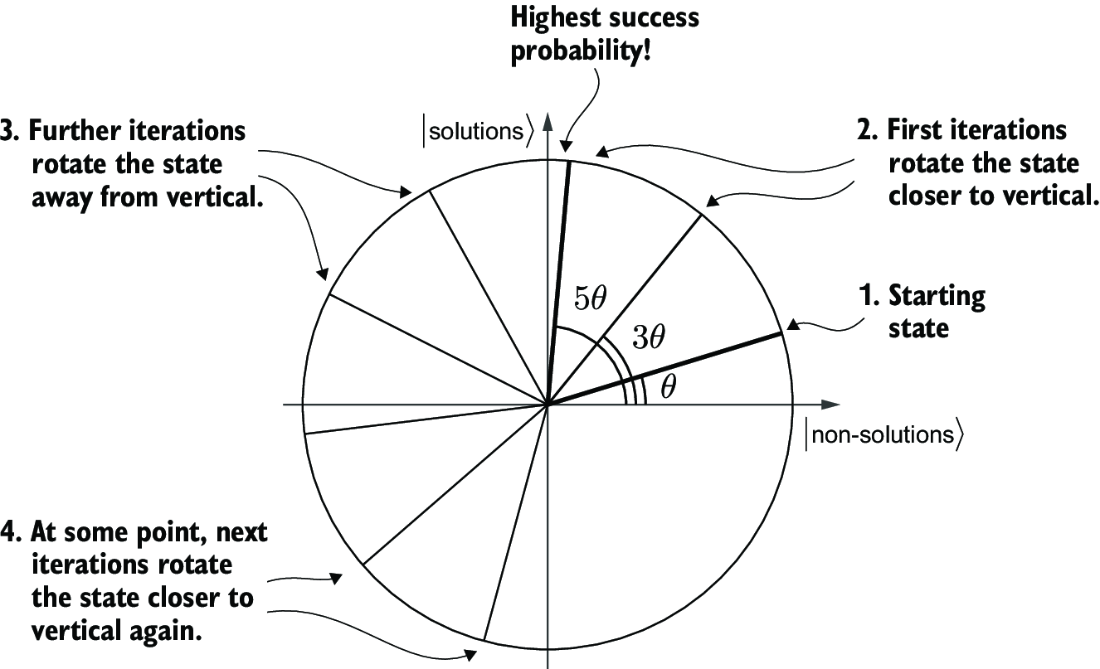
The state-space diagram makes the operational purpose visible: each oracle-plus-reflection iteration rotates the state closer to \(\ket{\mathrm{solutions}}\) only until it passes the optimal point. Extra iterations rotate past that axis and reduce success probability. section 7.2.2
Choosing when to stop
Suppose repeated Grover iterations move the state toward the solutions axis. While each rotation approaches that axis, solution-state amplitudes and the chance of measuring a solution increase. Once the state has passed the closest point, further reflections about the mean continue the rotation and lower that probability instead. Select the iteration count before this overshoot, then check the measured answer with the search function. section 7.2.2
