A wrong answer tells an agent that something failed, but not where. A reflection signal turns the run into a written diagnosis: an agent or critic reads the trajectory and explains what went well, what went poorly, and what should change. Unlike a score, the critique can point to a specific step or missing instruction. section 3.3.1 section 1.4.1
Find the skipped filter
Suppose a revenue agent reports incorrect totals. A checker can flag the totals; a reflector can inspect the tool calls and suggest that the agent failed to filter an internal channel. A proposer can then rewrite the prompt to address that suspected gap instead of making a blind edit. The diagnosis guides a candidate change—it does not prove the change works. section 3.3.1 section 4.2.2
A practical reflection loop separates diagnosis from action:
- Collect the candidate prompt, user question, numbered trajectory, and final answer. Tool telemetry and raw outputs give the critic visibility that a judge of finished answers lacks. section 3.3.1
- Ask a model for a brief critique. Store it as feedback in a GapMeasurement, leaving the score empty; no reference answer, labels, or ground truth are required. section 3.3.1
- Use the critique to propose a targeted prompt edit, then run and select candidates using an evaluation signal. Reflection supplies reasons for an edit, not its acceptance verdict. section 4.2.1 section 4.2.2
Figure 3.8 The reviewer's desk. The reflection signal assembles exactly what a human reviewer would want open: the candidate prompt under critique, the user's question, the trajectory as numbered steps, and the final answer. A single model call reads all four along with the reflection instructions and returns a written critique, which the framework packs into a GapMeasurement with feedback filled and score left empty. No ground truth, no labels, no reference answer; a trajectory is the whole requirement.
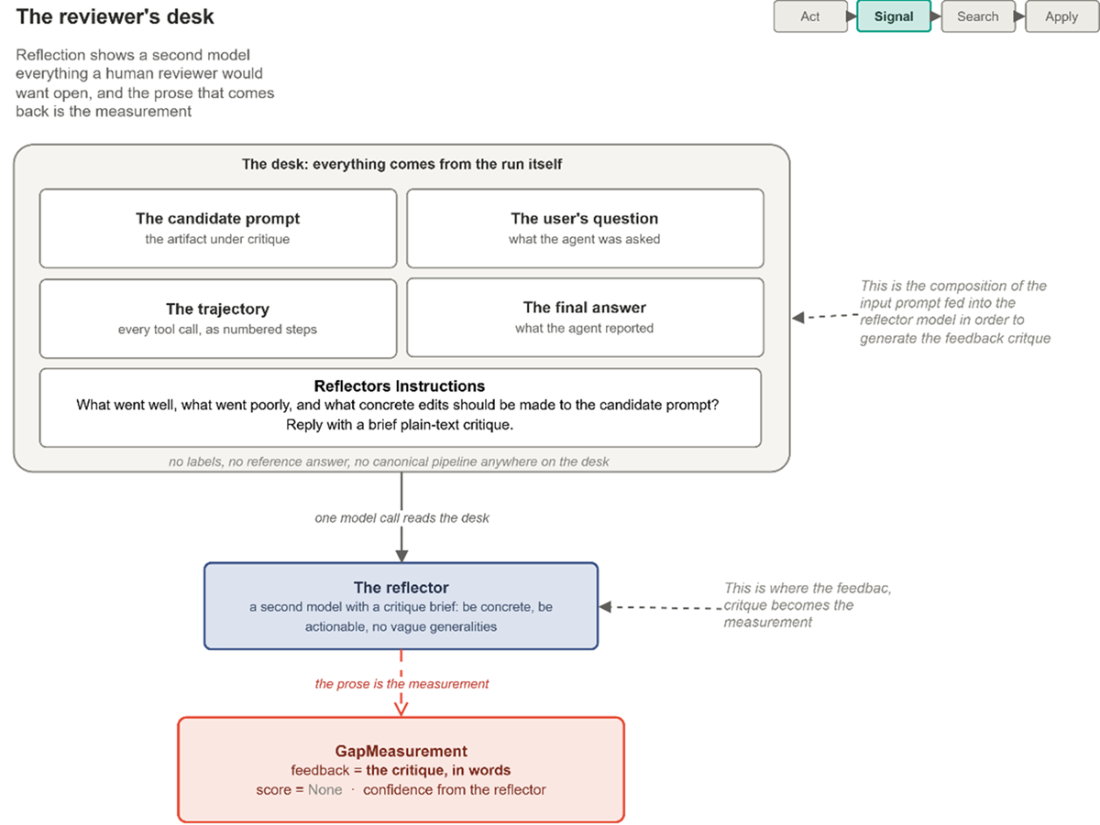
The reviewer’s desk shows the inputs to one reflection call and its output: written feedback rather than a numeric score. section 3.3.1
Reflection is useful when the final answer hides a fragile path. The extra trace information makes it more informative than judging an answer alone, but costs another model call and can still produce a mistaken diagnosis. If a loop relies only on its own reflections, improvement can flatten; execution results, ground truth, or new evidence can provide a stronger check. section 3.3.1 section 1.4.1
