Refraction occurs when a wave passes between media with different densities. The change in density alters the wave’s speed, causing it to bend. section 18.1.2
Distinguish refraction from other electromagnetic-wave behaviors:
- Absorption converts wave energy into heat and weakens the signal. section 18.5
- Reflection bounces waves from surfaces, while diffraction bends and spreads them around obstacles. section 18.1.2
- Scattering spreads waves erratically after interaction with irregular surfaces or media. section 18.1.2
Everyday example
An object viewed in water from above appears shifted because light bends as it travels from water into air. section 18.1.2
Figure 18.4 Phenomena affecting the behavior of electromagnetic waves include absorption by a medium, reflection off surfaces, refraction (bending) as waves pass through a medium, diffraction around obstacles, and scattering from irregularities.
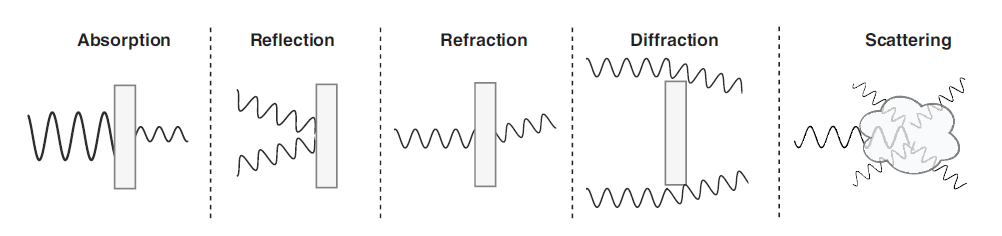
Use the figure to compare refraction with absorption, reflection, diffraction, and scattering in wireless propagation. section 18.1.2
