A promise is rejected when its asynchronous operation fails. Its associated value is the rejection reason, and once rejected, the promise is settled: its state and value cannot change. section 8.1.1
A promise can become rejected in these ways:
- Calling reject(reason) in the executor rejects it with that reason. section 8.1.1
- Throwing from the executor also rejects it; throwing in a then callback rejects the promise returned by then. section 8.1.1 section 8.1.2
Figure 8.1 The possible states of a promise: pending, fulfilled, rejected. The value associated with the rejected state is often called a reason.
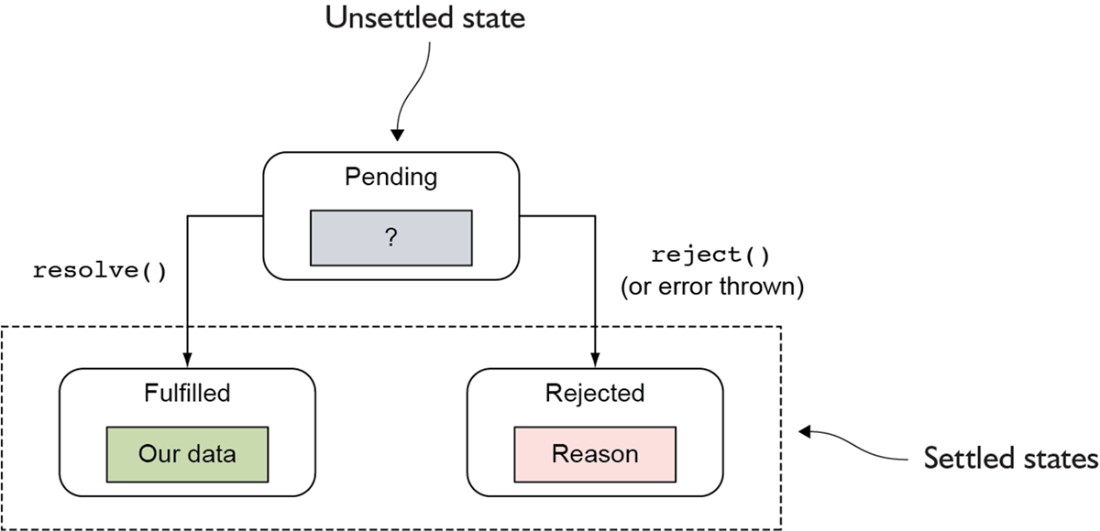
The diagram shows rejection as one of the three promise states and labels its associated value as a reason. section 8.1.1
Listing 8.3 Using promise chaining to handle a fetch result
fetch("https://jsonplaceholder.typicode.com/posts/1") #A
  .then((response) => { #B
    if (!response.ok) { #C
      throw new Error(`Status code ${response.status}`); #D
    }
    return response.json(); #E
  })
  .then((json) => { #F
    console.log(json); #F
  }) #F
  .catch((reason) => { #G
    console.error(`Request failed: ${reason}`); #G
  }) #G
  .finally(() => { #H
    console.log("Request finished"); #H
  }); #H
The fetch chain throws when the response is unsuccessful and sends request, status, or JSON errors to catch. section 8.1.2

