Rejection sampling (RS) is a preference-fine-tuning method that generates candidate completions, scores them with a trained reward model, and trains on only the strongest outputs. It can follow instruction fine-tuning, reinforcement-learning optimization, or RLVR. The current model supplies samples, while the reward model acts as a filter for high-quality completions. section 9.0 section 9.4
A practical rejection-sampling pipeline consists of four stages:
- Select training prompts and a reward model; reusing every instruction-tuning prompt is simple but may overfit. section 9.1
- Generate multiple completions from the starting checkpoint, configuring temperature, top-p, sequence length, and completions per prompt. section 9.1
- Rank completions with the reward model and optionally deduplicate them; retain either the best completion per prompt or the globally highest-scoring K. section 9.1 section 9.4
- Instruction-fine-tune the starting checkpoint on the retained completions. section 9.1
Rejection sampling versus Best-of-N
Both methods generate and reward-score several completions. Rejection sampling fine-tunes the model on selected outputs; Best-of-N uses the highest-scoring output only at inference time and does not update the model. section 9.4
Figure 9.1 RS overview
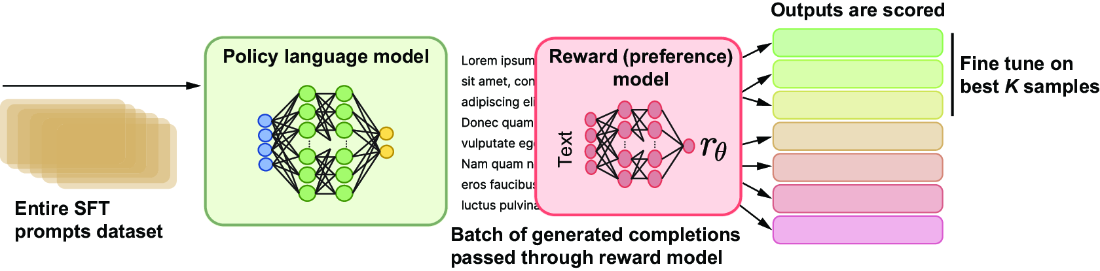
Use the pipeline overview to inspect how prompt selection, generation, reward ranking, and supervised fine-tuning connect. section 9.1


