Related patterns are connected solutions within a domain. A pattern language collects patterns that work together to solve problems in that domain. section 7.6.1
Patterns can relate in several ways:
- A successor solves a problem created by applying a predecessor. section 7.6.1
- Alternatives solve the same problem. section 7.6.1
- A specialization narrows another pattern; patterns addressing the same area can also be grouped or generalized. section 7.6.1
Figure 7.11 The visual representation of different types of relationships between the patterns: a successor pattern solves a problem created by applying the predecessor pattern; two or more patterns can be alternative solutions to the same problem; one pattern can be a specialization of another pattern; and patterns that solve problems in the same area can be grouped, or generalized.
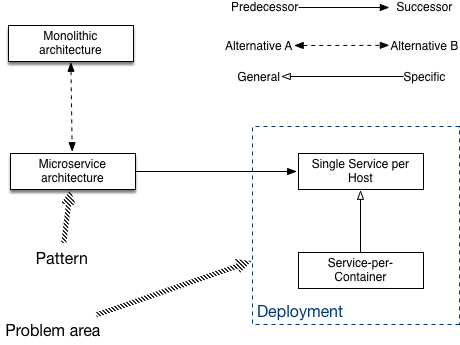
Use the diagram to compare the four relationship types. section 7.6.1
