A related query is a query associated with another query through shared meaning or search behavior. Relatedness can include refinements, misspellings, or queries about the same topic, such as “iphone,” “pink phone case,” and “pink iphone case.” section 6.3
Query logs provide a practical signal: each record includes a user, query, and timestamp. Queries entered close together may represent a refinement or related topic, but reliable relationships require patterns repeated across many users rather than one person’s behavior. section 6.3
Worked query pairs
A query-log sample contains 725,459 keyword–user pairs and 244,876 co-occurring query pairs. Strong candidates include “green lantern” with “captain america” for 23 shared users, “iphone 4s” with “iphone” for 21, and “laptop” with “hp laptop” for 20. Sparse counts can still contain noise, so filtering and composite ranking remain necessary.
Figure 6.2 A typical sequence of searches from query logs for a particular user
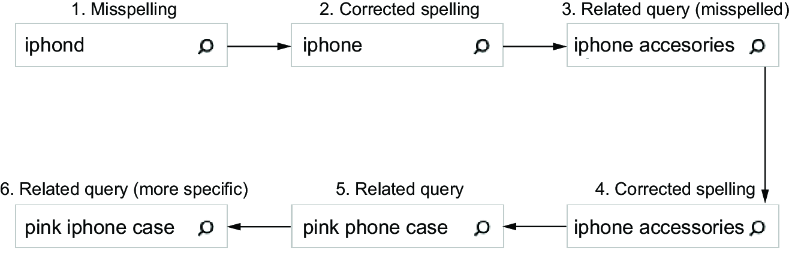
Inspect the search sequence to see how successive queries can reveal refinements, misspellings, and topical relationships. section 6.3
Related-query signals can support query expansion and improve recall, but they are not automatically reliable. General terms may co-occur frequently without a strong relationship, while limited co-occurrence data increases noise. section 6.3 section 6.3.1
