Imagine finding Alice’s orders by following a maze of physical record paths. If the disk layout changes, the application can break. The relational model separates data from physical storage: it represents information in tables, or relations, linked by shared values. section 8.2.1
Figure 8.2 Showing how Primary Keys and Foreign Keys work together to link tables. The child table (Orders) uses the Customer_ID as a Foreign Key to point directly back to its parent record (Customers), establishing a clear one-to-many relationship.
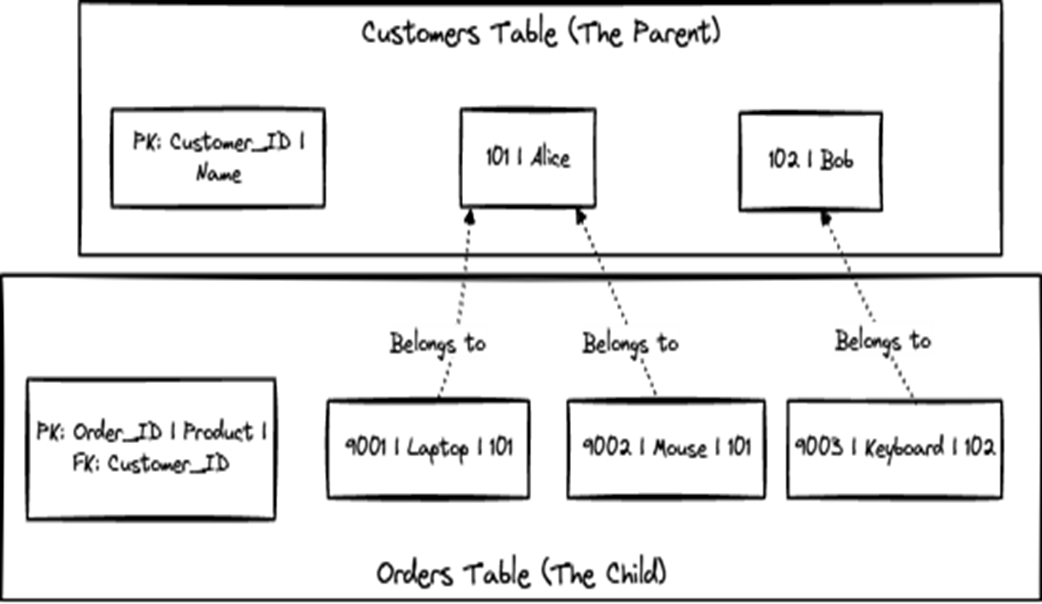
An Orders table uses Customer_ID as a foreign key to link each order to a customer. One customer can have many orders. section 8.2.1
Normalization organizes data to reduce duplication and protect integrity. For example, keeping an address in one place helps avoid updating one copy while forgetting another. section 8.2.1
Relational queries are declarative: you specify what data you want, and the database engine decides how to retrieve it. SQL grew from the model’s mathematical foundations. section 8.2.1


