When agents rebuild the same dependencies independently, each iteration pays for work already done elsewhere. Remote caching stores reusable build artifacts on a shared cache server, allowing other agents to download them instead of recompiling. A local cache helps only the agent on that machine; a shared cache can benefit the whole team. section 10.3.3
Reuse a compiled dependency
Agent A compiles shared-utils version 3.2.1 and uploads the artifact. Agent B imports the same version and downloads it rather than compiling it again. In this example, the dependency build drops from three minutes to 200 milliseconds. section 10.3.3
Figure 10.4 Remote caching: Shared cache gets warmer as more agents run.
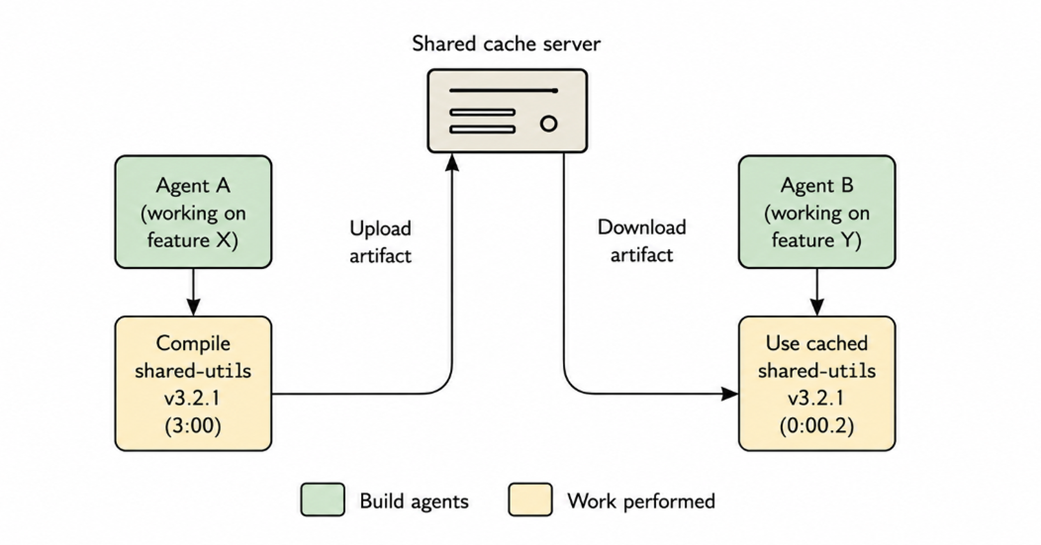
The figure illustrates how agents contribute to and benefit from a shared cache. section 10.3.3
More agents can warm the cache for one another, reducing the cost of later iterations. But savings are not free: cache infrastructure and CI runners cost money, and review still consumes engineering time. Measure the team’s actual costs rather than assuming a vendor benchmark or a universal savings ratio. section 10.3.3 section 10.3.6
Check whether the investment improves the whole feedback loop:
- Track cost per iteration, including tokens, CI time, and developer attention. One team observed a drop from $0.95 to $0.31 over six weeks as the cache warmed and more agents contributed. section 10.3.3 section 10.7.1
- Track CI feedback latency at P50, P95, and P99. A warm cache does not eliminate runner contention: one team added runners after burst traffic pushed P99 to 18 minutes. section 10.7.1
- Fix unreliable tests before optimizing for speed. Faster feedback is not useful if tests send agents after false failures or create false confidence. section 10.9
