liveBook · Manning

Repeated solution recombination

As explained in Optimization Algorithms: AI techniques for design, planning, and control problems

A search strategy that combines parts of existing solutions to construct new candidate solutions.

Repeated solution recombination searches for better candidates by combining parts of existing solutions instead of constructing each solution from scratch. It belongs to heuristic and metaheuristic search, alongside repeated solution construction and repeated solution modification. section 2.3

Combining two candidate solutions

Given solutions S1 and S2, take the first two elements of S1 and append the last eight elements of S2. The resulting candidate is better than the original solutions in the illustrated example. section 2.3

Figure 2.21 Repeated solution recombination—taking the first two elements of S1 and adding the last eight elements of S2 yields a new, better solution.
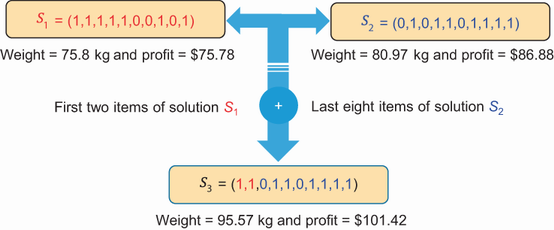
Visualizes recombination by showing how segments from S1 and S2 form a new candidate solution. section 2.3

How Optimization Algorithms: AI techniques for design, planning, and control problems covers it

How deep it goes
Defines the strategy and illustrates one recombination, without detailing operators, parameters, or implementation steps.
Examples
Illustrates recombination by joining the first two elements of S1 with the last eight elements of S2.
What it assumes
Assumes familiarity with candidate solutions and distinguishes recombination from construction and modification strategies.
What you can do after
Understand how combining solution segments can produce a new candidate for heuristic search.
How it connects
Connects recombination with genetic algorithms, differential evolution, and broader heuristic search.

Related concepts

This explainer was generated by Manning's knowledge graph from the text of Optimization Algorithms: AI techniques for design, planning, and control problems. The section links point to the parts of the book it draws on.