A replica is a running application instance managed by Kubernetes. Replicas let one application run as multiple equivalent instances instead of relying on a single instance. section 1.2.4 section 3.3.3
A Deployment records the desired number of replicas. Kubernetes compares that desired state with the current state, creates or removes Pods as needed, and keeps the application running. section 3.3.3
A replica participates in the application lifecycle as follows:
- A controller creates objects for application instances after the manifest reaches the Kubernetes API. section 1.2.4
- The scheduler assigns each instance to a node, and the Kubelet runs it through the container runtime. section 1.2.4
- A Service can distribute client connections across the Pods containing the replicas. section 3.3.3
Scaling to three replicas
Run `kubectl scale deployment kiada --replicas=3`. Kubernetes changes the Deployment's desired replica count and creates enough additional Pods to reach it. `kubectl get deploy` then reports three available instances, while `kubectl get pods` shows three separate Pods. section 3.3.3
Figure 3.12 Load balancing across multiple pods backing the same service
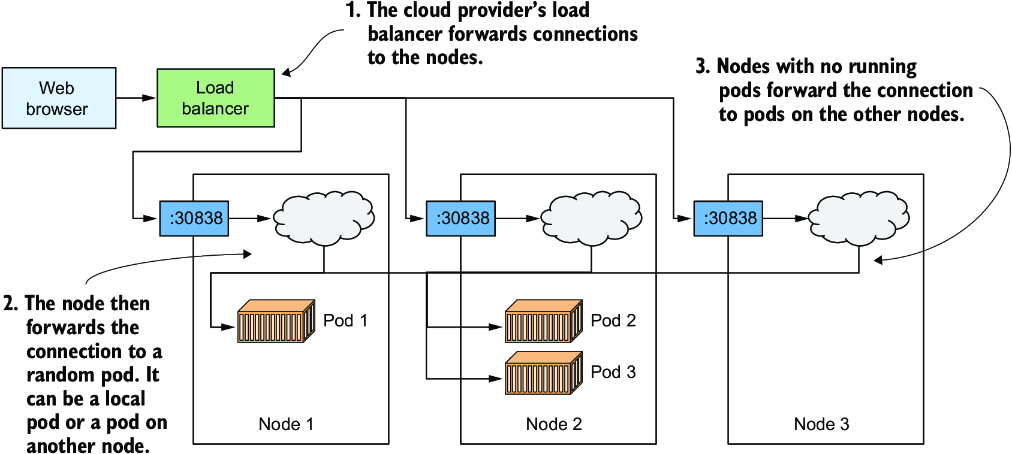
Shows how a Service load-balances requests across multiple Pods backing the same application. section 3.3.3











