A representative blind test set measures a classifier against real user inputs without exposing those inputs during model development. It preserves the production frequency of topics, so accuracy reflects what users actually ask for rather than an artificially balanced sample. section 4.2.1
Build the set from production evidence:
- Sample production logs containing naturally phrased customer utterances and their realistic intent distribution. section 4.2.1
- Have a human review each utterance and assign the definitive correct, or golden, intent. section 4.2.1
- Keep the test questions and answer key together, then use the set to establish baseline accuracy and assess future changes. section 4.2.1
- Use the observed topic frequencies to prioritize weak areas, especially problems affecting frequently asked topics. section 5.1
From production log to evaluation set
A sampled log entry retains the user’s naturally worded utterance, compares the system’s returned intent with a human-assigned golden intent, and stores the correct intent as the answer key. Repeating this across the production distribution creates a reusable set for measuring accuracy. section 4.2.1
Figure 4.5 K-fold cross validation and generated test data are suitable for situations where representative data is not available. Once a solution is deployed to production, representative blind test data will produce the most reliable measurement of your classifier’s ability to understand.
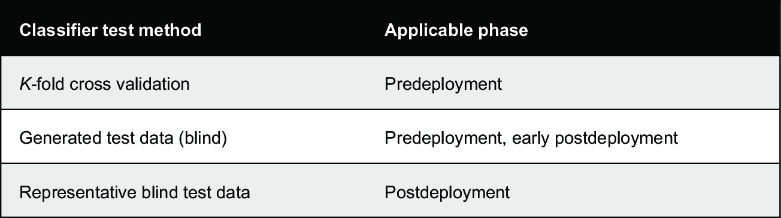
Use the comparison to choose an evaluation method: k-fold testing or generated data can fill predeployment gaps, while representative blind data is most reliable once production logs exist. section 4.2.1
