Reproduction generates new candidate solutions from parent solutions in an evolutionary algorithm. Usually, two individuals produce offspring, passing on a mixture of their genes. The process creates new possibilities that later generations can improve through selection. section 4.1
Reproduction fits into evolutionary search through three connected ideas:
- Selection favors individuals with higher fitness, making them more likely to become parents. section 4.1
- Crossover mixes genes from the parents, giving offspring traits from both. section 4.1
- Mutation introduces small random changes, preserving variation instead of copying parents exactly. section 4.1
A parent pair creates an offspring
Imagine two candidate solutions represented by genetic codes. Reproduction combines parts of both codes to form a new offspring. A small mutation may then alter one part. Repeating this cycle across generations produces varied solutions and can gradually favor better-performing ones. section 4.1
Figure 4.3 A simple example of reproduction and mutation
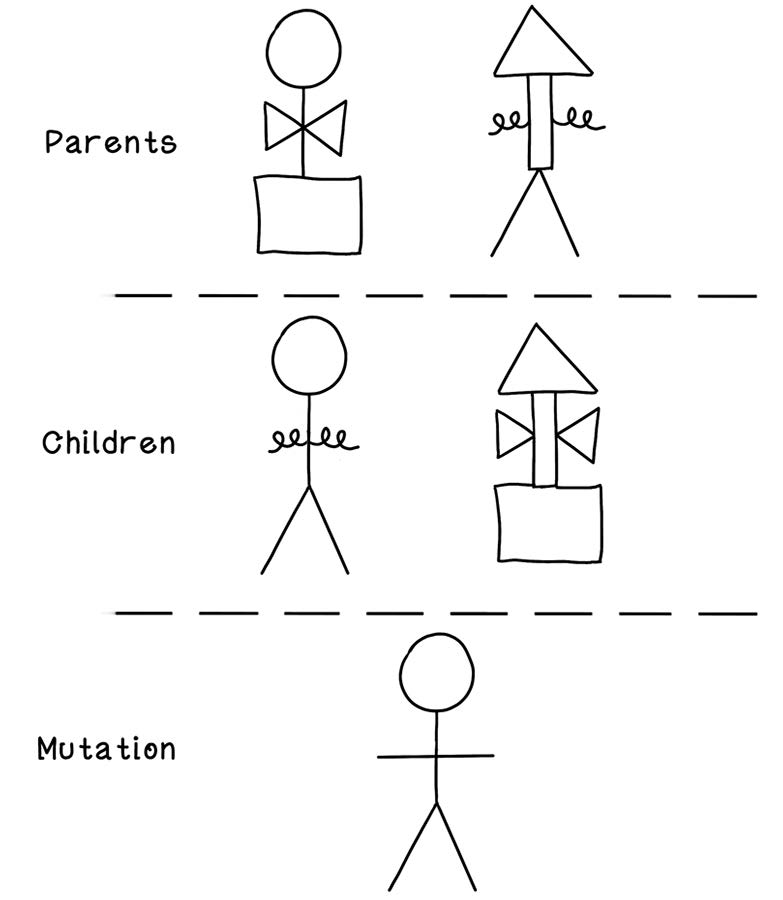
Use the reproduction-and-mutation figure to trace how parent genetic material becomes an altered offspring. section 4.1

