Reprogramming adapts a pretrained language model so it can perform a different task, such as time-series forecasting. Time-LLM aligns numeric time-series patches with the text modality used by an LLM, then learns to produce numeric forecasts. section 9.1 section 9.6
A forecasting reprogramming pipeline typically:
- Patches the raw time series and transforms the patches into representations aligned with the LLM’s text modality. section 9.1 section 9.6
- Combines the reprogrammed patches with a natural-language prompt that supplies context about the series. section 9.1 section 10.2.8
- Projects the LLM output and maps the resulting embedding through a linear layer to produce numeric forecasts. section 9.1
- Trains the reprogramming and projection components with a loss function such as mean absolute error before prediction. section 9.2.2
Store sales and blog visits
Time-LLM forecasts weekly sales for multiple stores through neuralforecast, and it can receive a prompt describing weekly seasonality in daily blog visits. Cross-validation measures MAE and sMAPE. section 9.2.2 section 10.2.8 section 9.4
Figure 9.1 General architecture of Time-LLM. (Right) The raw series is fed to the framework and undergoes patching before entering the patch-reprogramming phase. (Left) A prompt is used to provide context about the data. The prompt and reprogrammed patches are joined as a patch embedding, which is sent to the LLM. Then the output is projected to create a forecast for our series.
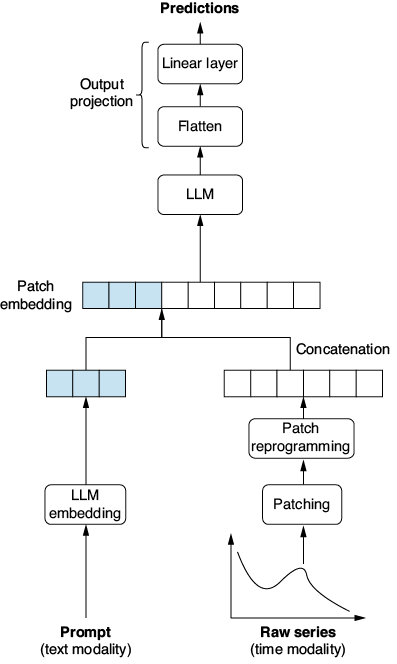
Use the architecture diagram to trace raw-series patching, prompt integration, LLM processing, projection, and numeric forecasting. section 9.1
