liveBook · Manning

Request tag

As explained in Think Distributed Systems

An ordering marker attached to a request to identify its position relative to other requests.

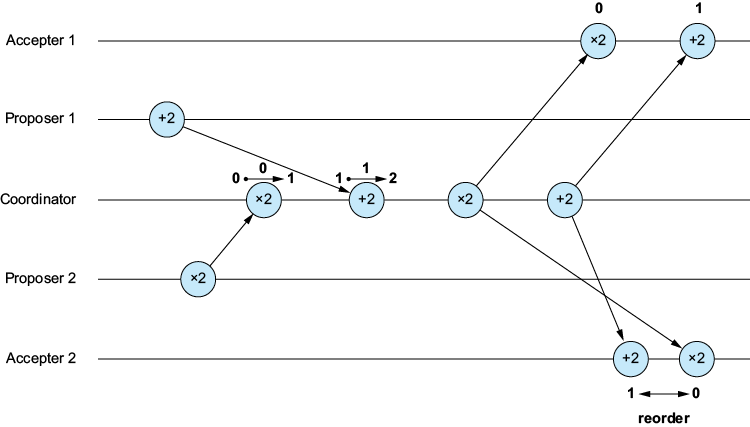
A request tag is an ordering marker attached to a request. A coordinator assigns tags from its current state, then increments that state for the next request. section 2.2

Acceptors track the latest request they have applied. When a request arrives with a larger tag, they know earlier requests are missing and can wait before applying it. section 2.2

Reordering delayed requests

Suppose P1 sends (+2) before P2 sends (×2), but the network delivers P2 first. The coordinator can tag P2 with 0 and P1 with 1. Acceptors then reorder the requests and apply (+2) after (×2), regardless of arrival order. section 2.2

Figure 2.12 Proposers, acceptors, and a coordinator
A line of white dots

AI-generated content may be incorrect.

The coordinator-and-acceptors diagram makes the tagging and reordering mechanism concrete. section 2.2

How Think Distributed Systems covers it

How deep it goes
Explains coordinator assignment, acceptor tracking, delayed application, and reordering, without broader protocol details.
Examples
Uses competing (+2) and (×2) requests whose network arrival order differs from their sending order.
What it assumes
Assumes basic distributed components, messages, network delivery, and local state; motivates the need to establish order.
What you can do after
Understand it by tracing how tags let acceptors detect missing requests and restore a consistent application order.
How it connects
Connects request tags to race conditions, coordinators, proposers, acceptors, and distributed systems.

This explainer was generated by Manning's knowledge graph from the text of Think Distributed Systems. The section links point to the parts of the book it draws on.