liveBook · Manning

Rescaling factor

As explained in Grokking Machine Learning

A rescaling factor is a multiplicative ratio used to increase the weights of incorrectly classified data points in the next boosting round.

In AdaBoost, a rescaling factor multiplies the weights of misclassified points so later weak learners give them more importance. It is the total weight of correctly classified points divided by the total weight of incorrectly classified points. section 12.3

Two rounds of reweighting

With ten equally weighted points, a weak learner classifies seven correctly and three incorrectly, giving a factor of 7/3 ≈ 2.33. In the next round, the correct points’ weights total 11 and the incorrect points’ weights total 3, so the factor is 11/3 ≈ 3.67. section 12.3

Figure 12.10 Fitting the first weak learner of the AdaBoost model. Left: The dataset, where each point gets assigned a weight of 1. Middle: A weak learner that best fits this dataset. Right: The rescaled dataset, where we have enlarged the misclassified points by a rescaling factor of 7/3.
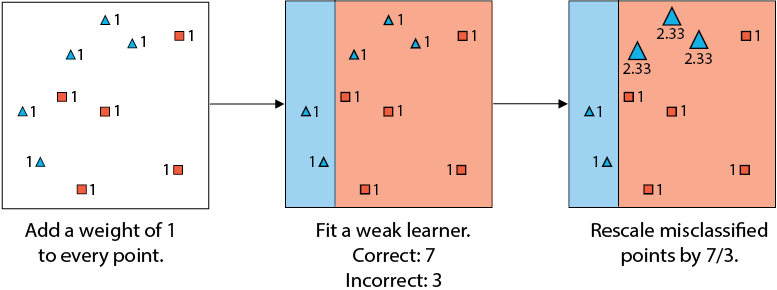
Compare the original dataset, the weak learner’s split, and the enlarged weights on misclassified points. section 12.3

How Grokking Machine Learning covers it

How deep it goes
Defines the weighted ratio and works through two numerical rounds before describing repetition.
Examples
Uses a ten-point triangle-and-square dataset, with factors 7/3 and 11/3 across two rounds.
What it assumes
Starts with point weights of 1 and defines how to compare correct and incorrect weights; no other background is specified.
What you can do after
Apply the ratio of correctly to incorrectly classified weight to calculate a factor and reweight mistakes.
How it connects
Connects AdaBoost with weak learners, decision trees, and weighted classification.

This explainer was generated by Manning's knowledge graph from the text of Grokking Machine Learning. The section links point to the parts of the book it draws on.