A research agent turns a request into a sequence of information-gathering and synthesis steps. Rather than relying only on an LLM’s training data, it can consult multiple sources, analyze what it finds, and produce a comprehensive answer. section 1.2.2
The LLM decides what to do next: which source to check, whether the results are sufficient, what to investigate further, and when to write. Tools provide actions such as web search, file access, and calculation; a loop lets the agent make further decisions as new information arrives. section 1.2.2 section 2.4.3
From question to report
Asked to summarize the 2024 Nobel Physics Prize winners’ research, an agent searches for the winners, explores academic papers and Wikipedia, then synthesizes a report on their achievements and effect on AI. section 1.2.2
Figure 1.2 User requests flow through the research agent, which branches into multiple searches and synthesis.
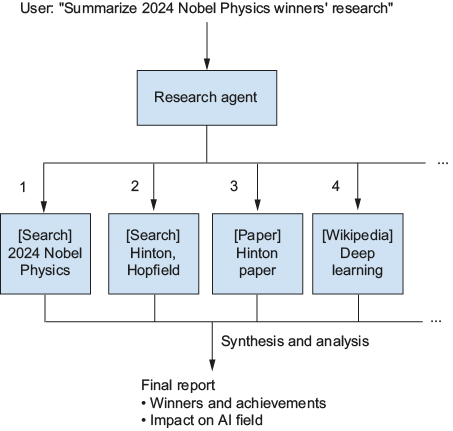
The branching searches show how one user request can require several information-gathering steps before synthesis. section 1.2.2
Measure progress against realistic questions with verifiable answers and varied difficulty, rather than judging improvements by prompt changes alone. GAIA provides such test cases. A tool-free LLM is a useful baseline, but training data is unreliable for precise, current, or verifiable answers; the agent needs external capabilities to address those gaps. section 2.4.1 section 2.4.3
