A resource is an addressable part of the Kubernetes REST API. It exposes cluster configuration through a URI and supports operations such as create, read, update, and delete using standard HTTP methods. section 4.1.1
Kubernetes uses “resource” and “object” almost interchangeably, but they describe different views: an object is represented through one or more resources, while each resource has its own address and representation. section 4.1.1
Deployment resources
The collection of deployments is exposed at /api/v1/deployments. A GET request returns the deployment instances. Each individual deployment also has a unique URI, which can be read with GET or modified with PUT. section 4.1.1
Resources participate in the Kubernetes object lifecycle:
- YAML or JSON manifests describe API objects and can be posted to create them. section 4.4
- GET requests retrieve an object and its current status; controllers update that status while managing the desired state in its spec. section 4.4
- Events are also API objects and provide clues about recent actions or failures affecting an object. section 4.4
Figure 4.2 A single object can be exposed by two or more resources.
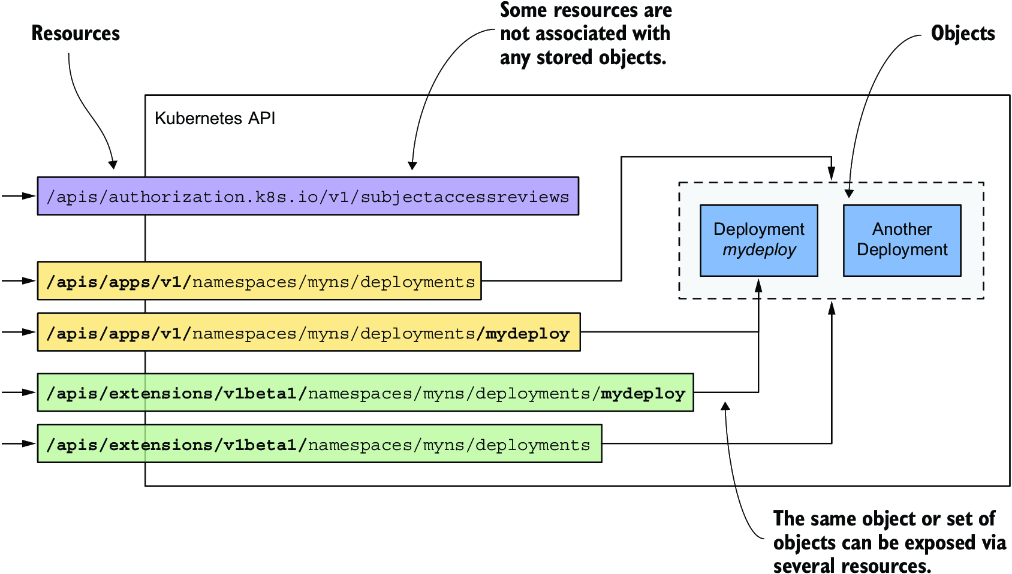
Use the figure to visualize how one Kubernetes object can be exposed through multiple resources or representations. section 4.1.1


