Subdomains can need different amounts or types of CPU, GPU, memory, network bandwidth, storage, and service instances. Because services scale by instance, combining subdomains with mismatched needs can overprovision resources. Separating them into services allows independent scaling, improving utilization and potentially reducing costs. section 7.4.5
Order management and fraud detection
An application needs 10 Order Management instances but only 5 Fraud Detection instances, which require GPUs. If both subdomains share a service, five instances’ fraud-detection capacity is underused. Separate services can scale each subdomain to its own needs. section 7.4.5
Figure 7.7 Subdomains within the same service are scaled together, which can require over-provisioning of some resources. Putting them in separate services enables them to be scaled independently which improves resource utilization and reduces cost.
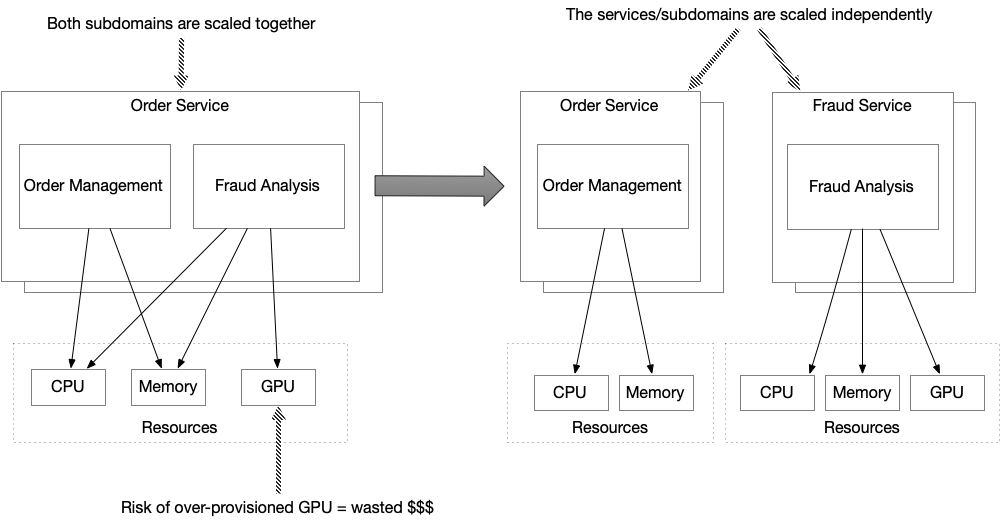
Compare coupled scaling within one service with independent scaling after separating subdomains. section 7.4.5
