Response filtering is an application-stack layer that analyzes generated prompts and responses, then filters or optimizes outputs to maintain safety, quality, and compliance. It supports responsible-AI goals by screening content for accuracy, bias, and appropriateness before delivery. section 10.2.3 section 10.2
A production-oriented filtering layer combines several controls:
- Use classifiers and natural-language-processing tools to screen outputs for accuracy, bias, and appropriateness. section 10.2.3
- Apply system-prompt constraints and prompt-engineering components to guide generation toward safe outputs. section 10.2
- Check grounded responses for syntactic correctness, semantic meaning, and relevance to the supplied context or domain. section 10.2
- Use caching to improve performance and support rapid rollback or suitability decisions for outputs. section 10.2.3
- Monitor outputs continuously and evaluate them in real time to maintain AI quality throughout the application lifecycle. section 10.2.3
- Integrate ethical decision-making, transparency, fairness, inclusivity, and regulatory compliance such as GDPR data privacy. section 10.2.3
Figure 10.4 GenAI app stack
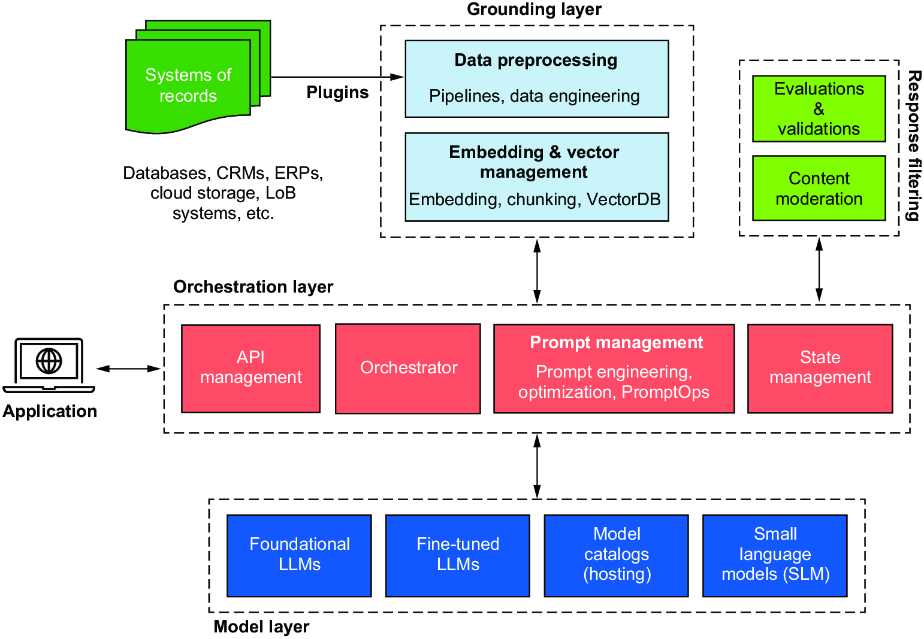
Use the GenAI application-stack diagram to locate response filtering between model orchestration and the user-facing experience, alongside grounding and plugin components. section 10.2.1 section 10.2.3
Filtering is part of a broader operational design: orchestration coordinates components, plugins ingest and transform enterprise data, and monitoring and logging support reliable deployment. The layer improves trust but requires explicit policies, evaluation criteria, and lifecycle oversight. section 10.2.1 section 10.2
