The resultant algorithm computes a single field value for two polynomials without using determinant or root-product definitions. It supports polynomial square-root tests by reducing the resultant to a quadratic-residuosity check. section 12.1
Its implementation follows this flow:
- Return zero when either input polynomial is zero. section 12.1
- Remove each polynomial's content by dividing coefficients by their greatest common divisor; monic polynomials already have content one. section 12.1
- Order the inputs by degree, initialize result variables, and set the sign state when both degrees are odd. section 12.1
- Repeat pseudo-division and update A, B, g, and h until B has degree zero; use its leading coefficient for the final result. section 12.1
Content removal
For a = 4x^4 + 24x^3 + 12x^2 + 4x + 32, the coefficient gcd is 4, so the first normalization divides every coefficient by 4. section 12.1
Figure 12.3 Resultant algorithm
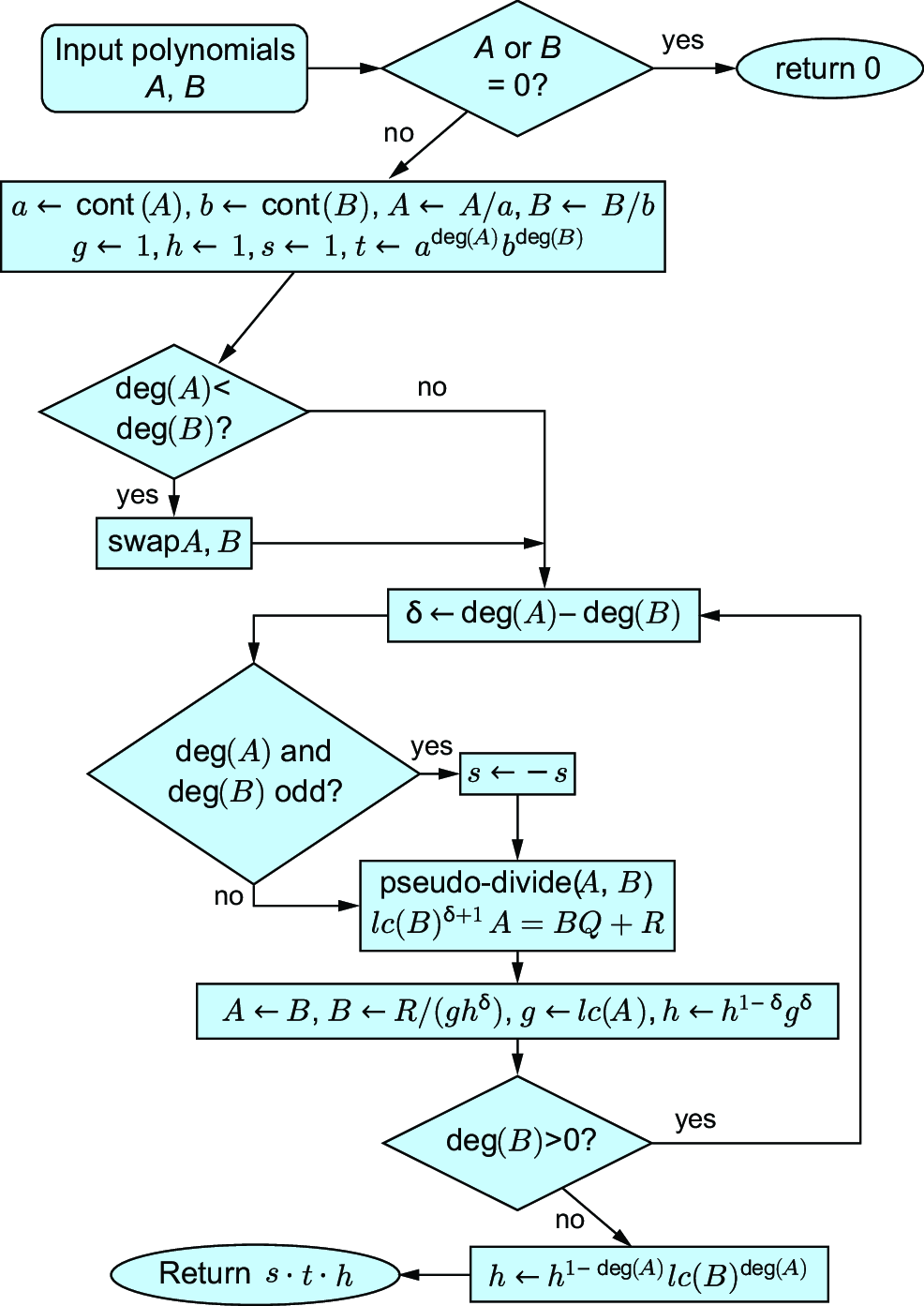
Use the algorithm figure to follow initialization, the pseudo-division loop, reductions, and final constant handling. section 12.1
Figure 12.4 Pseudo-division algorithm
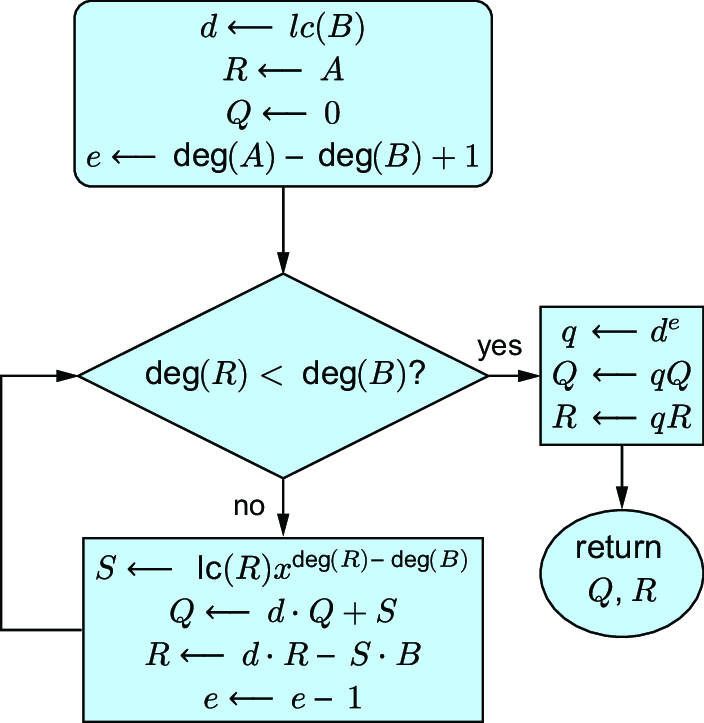
Consult the pseudo-division figure for the polynomial remainder operation used inside the main loop. section 12.1
