A results-driven approach is a pragmatic analytical workflow that prioritizes solving the stakeholder’s problem over demonstrating every possible skill. Define a useful first result early, deliver it as a minimum viable answer, and use feedback to decide what deserves deeper work. section 1.2 section 1.2.7
The approach accepts that real requests are often ambiguous, data may be incomplete, and the final scope cannot be known at the outset. Rather than wait for perfect understanding, it makes uncertainty visible and works toward a satisfactory answer that can create immediate value. section 1.0 section 1.2.7
Use the workflow to move from a vague request to an actionable first delivery:
- Understand the problem by defining key terms and clarifying what the stakeholder actually needs. section 1.2 section 2.3
- Start at the end by specifying the minimum viable answer that could begin a useful conversation. section 1.2 section 4.3
- Identify and obtain the necessary resources, including data, people, and access permissions; check whether the needed data exists. section 1.2
- Produce a first iteration quickly, ideally within days, while deliberately excluding work that is not essential yet. section 1.2 section 3.3
- Present preliminary findings, caveats, and possible next steps to stakeholders rather than working in isolation. section 1.2.6 section 2.3
- Iterate when feedback or unresolved uncertainty warrants it, estimating and planning one iteration at a time. section 1.2.7
Answering “How many cars did we sell yesterday?”
A seemingly simple dealership question requires definitions before filtering data: what counts as a car, a sale, and yesterday? A first answer can expose missing data or differing interpretations, enabling a stakeholder conversation before a larger analysis is built. section 1.2
A minimum viable answer is not permission to cut corners or avoid depth. It is a breadth-first judgment: learn and do what is needed for the current decision, then go deeper when the problem, feedback, or expected return justifies it. section 1.2.7 section 1.3
The workflow keeps analytical choices tied to intended use. For an open-ended product-performance request, selecting revenue, volume, popularity, or conversion changes the answer; the first deliverable should state the chosen measures, ranking, rationale, findings, and recommended iterations. section 4.3
It also applies beyond reports. When assessing property data for an application, analysis can focus on whether the available data supports the proof of concept, which gaps limit it, and which charts or features would help future users. section 10.3 section 11.4
Figure 1.1 The results-driven process visualized
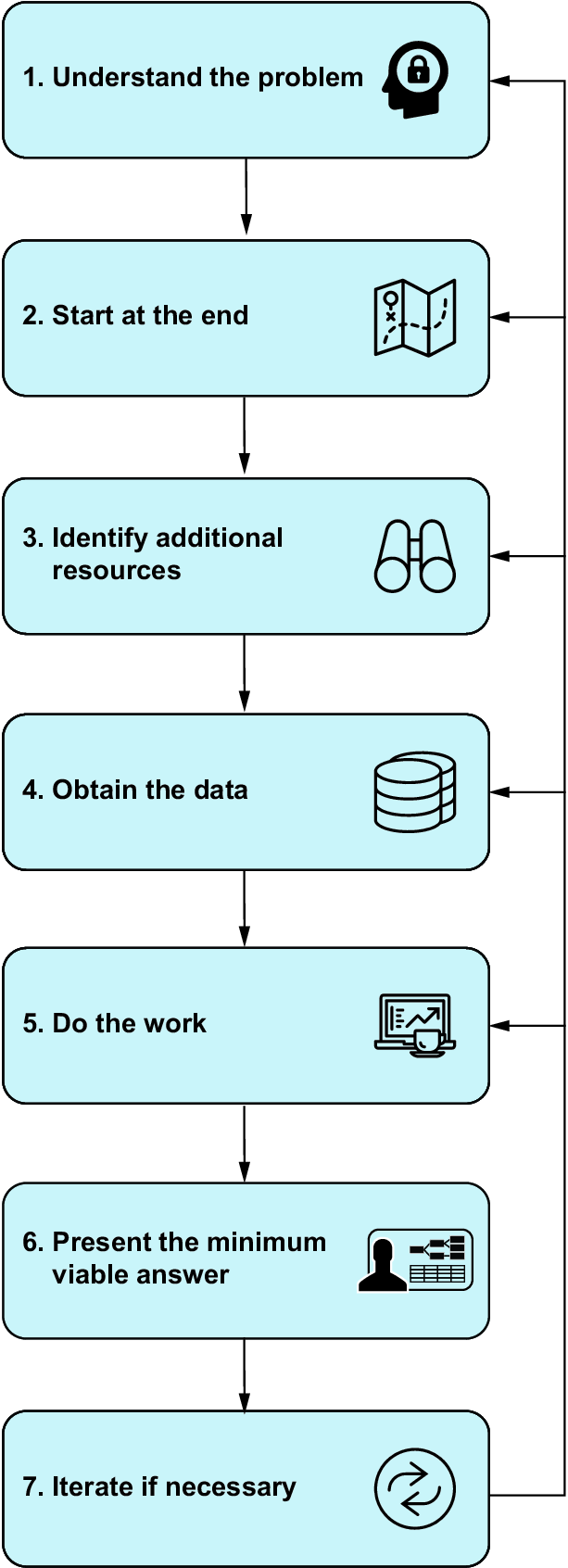
View the process as a sequence from problem understanding and minimum viable answer through stakeholder presentation and iteration. section 1.2
