The retrieval coverage problem is the gap between information available in a retrieval system and all information needed to generate a correct, complete answer. Relevant data may exist in the corpus while a single query embedding fails to retrieve it. section 8.1
A single-query RAG pipeline can lose coverage in several ways:
- Colloquial wording may miss technical terminology, such as “slow internet” failing to retrieve “packet loss on fiber connections.” section 8.1
- Complex intent may span separate semantic clusters, such as bandwidth throttling and packet loss. section 8.1
- A relevant document can fall just below the top-k cutoff, creating a Missed Top Rank failure even though it exists in the index. section 8.1
- Multi-query retrieval broadens coverage by generating several query variants, then combines their result lists with Reciprocal Rank Fusion rather than simply increasing k. section 8.0
Support bot misses the answer
A support bot receives “Why is my internet slow?” The vector database contains “Troubleshooting packet loss on fiber connections,” but the answer is not retrieved because the colloquial query and technical document occupy different semantic interpretations. Query expansion can express the intent through multiple retrieval paths. section 8.1 section 8.0
Figure 8.1 The coverage problem in single-query retrieval.
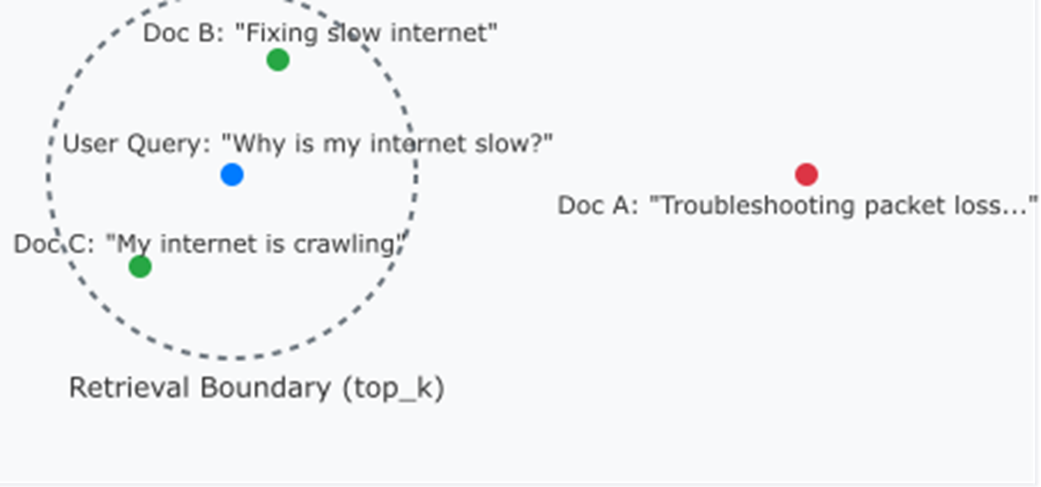
Use the figure to inspect how single-query retrieval leaves relevant information outside the retrieved context. section 8.1
Generating variants solves the coverage gap but introduces list-merging problems: results may be uncalibrated, duplicated, or contradictory. LangChain’s MultiQueryRetriever returns a de-duplicated union, but does not intelligently rerank it. section 8.2.1
