A retrieval-extractive pipeline answers open-domain questions in two stages: a sparse retriever finds relevant passages, then a comprehension model extracts a literal answer span from each passage. This architecture makes large-scale extractive question answering reproducible, but it struggles when the answer requires synthesizing facts scattered across documents. section 5.1
A typical implementation separates offline corpus access from online question answering:
- Search a large corpus such as Wikipedia with TF-IDF, BM25, or bigram hashing. section 5.1
- Pass each retrieved passage independently to a reader, originally RNN-based and later BERT-based. section 5.1
- Return the literal text span identified as the answer rather than generating a synthesized response. section 5.1
DrQA
DrQA combines bigram-hashing and TF-IDF retrieval over Wikipedia with a multilayer neural reader that locates answer spans inside retrieved paragraphs. section 5.1
Figure 5.1 DrQA Retrieval Extractive Pipeline.
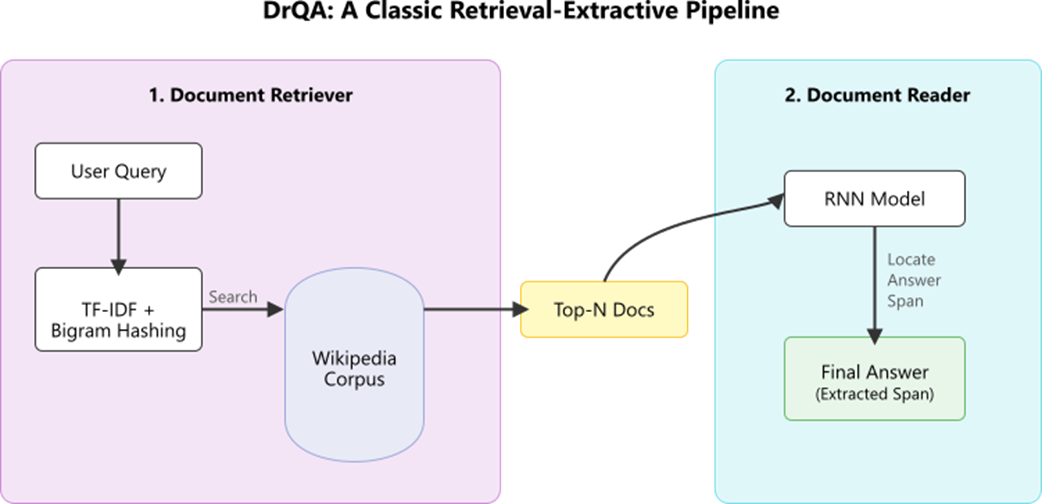
Use the pipeline diagram to trace retrieval, passage reading, and answer-span extraction as separate stages. section 5.1
