liveBook · Manning

Information retrieval

As explained in Building Reliable AI Systems

Retrieval is the process of finding relevant information from an external collection to supply as model context.

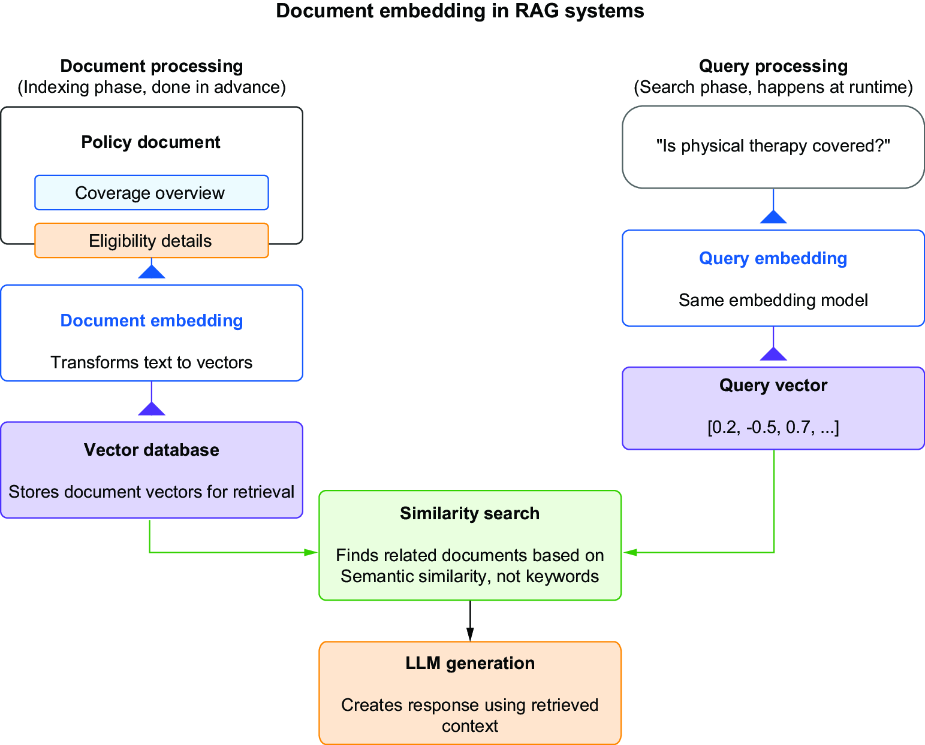
Information retrieval finds relevant information in an external collection and supplies it as model context. In retrieval-augmented generation, the system embeds documents and a user query, then uses similarity search to surface nearby document vectors. If relevant context is missed, a capable model and accurate source documents may still produce vague or outdated answers. section 4.0 section 4.1.1

Insurance policy chatbot

A patient asks whether physical therapy after surgery is covered. The answer exists in the policy documents, but the chatbot fails to find it; the retrieval pipeline, particularly its embedding model, is identified as the problem. section 4.0

Figure 4.1 Document embedding in RAG systems
figure

Trace how documents and a user query are embedded before similarity search retrieves candidate context. section 4.0


How Building Reliable AI Systems covers it

How deep it goes
Traces document and query embedding through vector storage and similarity search, without detailing search algorithms.
Examples
Uses a health-insurance chatbot that misses policy coverage information despite having access to the documents.
What you can do after
Diagnose how embedding quality can cause a retrieval pipeline to miss relevant context.
How it connects
Connects retrieval to retrieval-augmented generation, embeddings, vector databases, and similarity search.

Also explained in

Compare how 11 books explain information retrieval →

Related concepts

This explainer was generated by Manning's knowledge graph from the text of Building Reliable AI Systems. The section links point to the parts of the book it draws on.








