liveBook · Manning

Reward probability

As explained in Bayesian Optimization in Action

A reward probability is the probability that an action produces a reward in a stochastic reward process.

A reward probability is the chance that an action produces a reward in a random process. For a slot machine, p = 0.5 rewards roughly half of pulls, while p = 0.01 rewards roughly one in 100; the true value remains hidden. section 5.1.1

Choosing among slot machines

When several machines have different hidden reward probabilities, each pull supplies evidence but also consumes one opportunity. A strategic player must explore machines to discover which has the highest probability while exploiting promising choices to maximize total reward. section 5.1.1

Figure 5.1 A slot machine with an arm that can be pulled. The machine may return coins according to its reward probability when its arm is pulled.
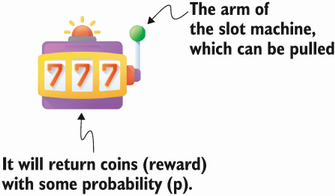
Use the slot-machine diagram to connect an action—the arm pull—with its probabilistic reward. section 5.1.1

How Bayesian Optimization in Action covers it

How deep it goes
Defines probability through slot-machine outcomes and examples, while leaving the hidden machine mechanism unexplained.
Examples
Uses casino slot machines, repeated arm pulls, and probabilities of 0.5 and 0.01.
What you can do after
Evaluate actions by their uncertain reward rates and identify choices likely to maximize rewards over limited pulls.
How it connects
Connects reward probability to multi-armed bandits, slot machines, exploration, and exploitation.

This explainer was generated by Manning's knowledge graph from the text of Bayesian Optimization in Action. The section links point to the parts of the book it draws on.