Reweighting changes which training examples receive attention during iterative learning. In AdaBoost, examples classified incorrectly receive higher weights, so the next weak learner focuses on repairing earlier mistakes. section 4.2.1 section 4.6
An AdaBoost reweighting cycle proceeds as follows:
- Start with equal weights for all training examples. section 4.2.1
- Train a weak learner, such as a decision stump, using the weighted examples. section 4.6
- Increase the weights of misclassified examples before training the next learner. section 4.2.1
- Combine the diverse weak learners through a weighted additive ensemble. section 4.2.1 section 4.6
Three decision stumps
The first stump receives equally weighted examples. After its errors receive larger weights, a second stump prioritizes those cases; a third responds to the next set of mistakes. Although the individual stumps have error rates of 15%, 20%, and 25%, their combined ensemble reaches 9%. section 4.2.1
Figure 4.4 At the start of iteration 2, training examples misclassified in iteration 1 (shown with larger markers in figure 4.3, right) are assigned higher weights. This is visualized on the left, where each example’s size is proportional to its weight. Since weighted examples have higher priority, the new decision stump in the sequence (right) ensures that these are now correctly classified. Observe that the new decision stump on the right correctly classifies most of the misclassified examples (shown larger) on the left.
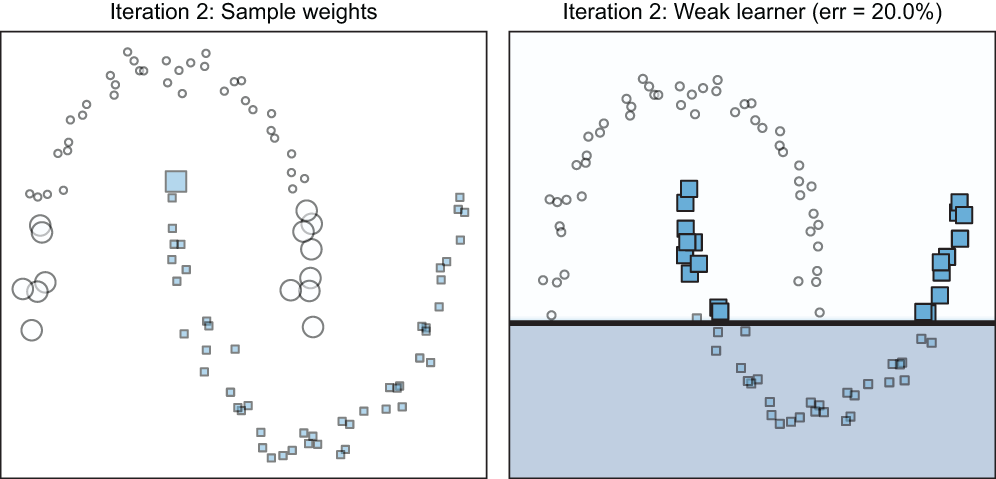
Use the visual progression to see how larger markers represent higher-weight examples and redirect each successive stump. section 4.2.1
