Fast flow requires more than a change in architecture. The fast flow success triangle combines DevOps as the development process, an organization structured using Team Topologies, and an architecture that enables both. Weakness in any element can prevent an organization from realizing the benefits of the others. section 1.1.3 section 2.3
Figure 1.3 Fast flow requires a combination of three elements: DevOps as the development process, an organization structured using the Team Topologies patterns, and an architecture that enables DevOps and Team Topologies.
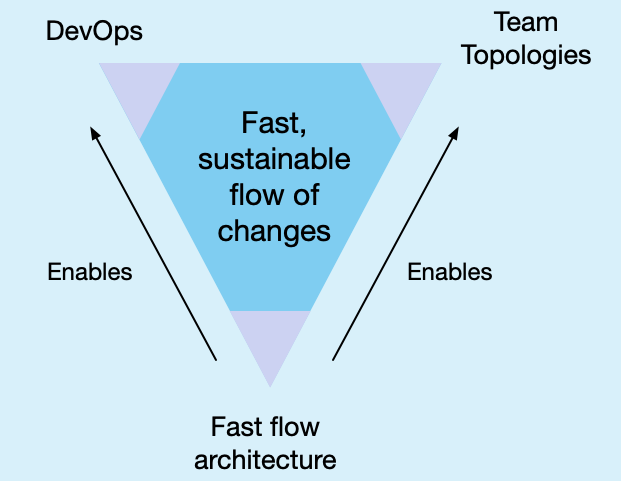
The triangle relates the three elements needed for fast flow. section 1.1.3
The elements have distinct responsibilities:
- DevOps is an organization-wide way of working for delivering software quickly and reliably, not merely a team name or infrastructure job title. Its three ways emphasize the flow of changes to production, feedback into development, and continual experimentation and learning. section 1.1.3
- Team Topologies structures the organization around stream-aligned teams that turn requirements into production code. Platform, enabling, and complicated-subsystem teams support them; teams primarily consume one another’s work as a service, while also collaborating or helping each other improve when needed. section 1.1.3
- Enabling architecture supports the development process and team structure. Microservices are one possible architectural choice, but adopting them alone does not establish the other two elements. section 1.1.3 section 2.3
Diagnosing slow delivery in a monolith
Before migrating a slow-moving monolith, check whether the architecture is actually the constraint. Modularizing it so teams own loosely coupled modules may help; the organization may also need to adopt DevOps, Team Topologies, and an automated deployment pipeline. Consider migration only if those changes are insufficient and microservices offer a tangible benefit. section 1.4.2 section 2.3
If migration is justified, migrate incrementally rather than rewriting everything at once: incremental delivery provides earlier value and feedback on design decisions. Microservices also introduce costs, including distributed operations and the risk of a distributed monolith. Making services too fine-grained can create tight coupling and poor performance. section 1.4.2 section 1.3.4 section 2.3
