The more the merrier anti-pattern arises when an organization takes “micro” too literally and adds services indiscriminately. The result is an overly complex, fine-grained architecture that is difficult to understand and maintain, inefficient because of network-call overhead, and brittle because of runtime coupling. section 1.3.4
Add a service only when it solves an actual problem. Service boundaries are consequential: consider the trade-offs, and prefer a simpler architecture when extra services create more operational complexity than value. section 1.3.4
Five services, five developers
A team with five developers and five services struggled to test its services. Merging them into one service simplified the architecture and solved the testing problem. section 1.3.4
Figure 1.13 Some, but not all, operations in a microservice architecture will span multiple services. Distributed operations are more complicated to design because services are process and transaction boundaries. This creates numerous design challenges since the network is not free, it’s unreliable, and not all services are guaranteed to be simultaneously available. You must also use an unfamiliar transaction model known as eventual consistency.
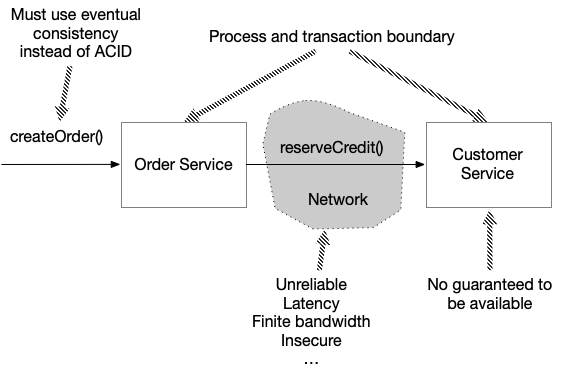
Distributed operations show why service proliferation can be costly: cross-service work adds network and transaction challenges. section 1.3.4
