The ridge point is where the Roofline model’s memory-bandwidth limit meets its compute limit. Calculate it as peak FLOPS divided by peak bandwidth: below the threshold, a kernel is memory-bound; above it, compute-bound. section 10.3
The threshold changes with the GPU. Wasted memory traffic lowers effective bandwidth and raises the effective ridge point, making compute-bound performance harder to reach. section 10.6
When a math-heavy kernel is still memory-bound
A kernel doing 100 operations while reading and writing one float moves 8 bytes, for an arithmetic intensity of 12.5 ops/byte. That is just above an 11.1 ops/byte ridge point, so ideal access would make it slightly compute-bound. With stride-8 access, effective bandwidth falls to about 112 GB/s and the effective ridge point rises to about 89 ops/byte; the kernel is then memory-bound. section 10.12
Figure 10.2 The Roofline model for our example GPU (10 TFLOPS, 900 GB/s). Attainable performance follows the memory roof up to the ridge point at about 11.1 ops/byte, then flattens along the compute roof. The increment kernel (0.125 ops/byte) and the 50-add kernel (6.25 ops/byte) both land on the memory roof, so both are memory-bound. Both axes are logarithmic, so that intensities from 0.1 to 100 ops/byte fit on one graph.
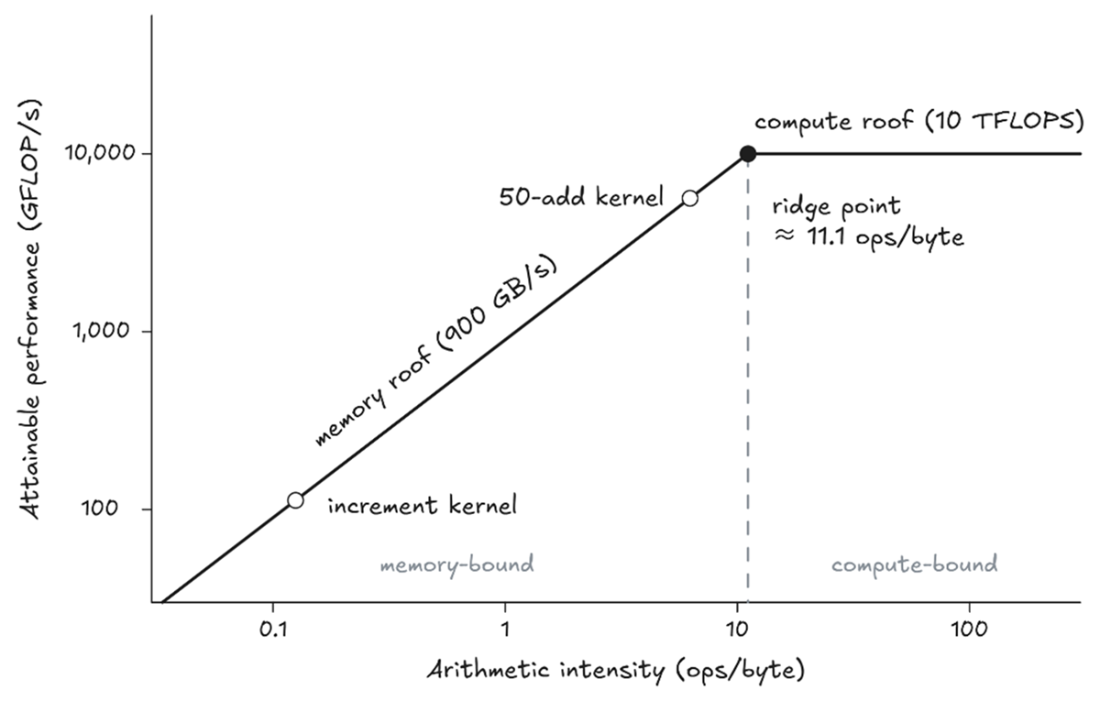
Use the Roofline figure to see how the memory and compute limits meet at the ridge point. section 10.3

