Right-to-left processing compares a candidate pattern occurrence from its final character toward its first. In Horspool’s algorithm, a mismatch triggers a lookup of the mismatching text character in the bad character shift table, allowing the search window to advance instead of shifting blindly by one. section 6.0 section 6.1
Compare from the pattern’s end
For the pattern “abcdabcy,” the first comparison checks the text character “d” against the pattern’s final “y.” On a mismatch, the table assigns “d” a shift of four, so the search window advances four positions. section 6.2
Figure 6.2 The letter ‘d’ in the text is compared with ‘y’ in the pattern as scanning is done from right to left. It’s a mismatch. So, checking the bad character table for the letter ‘d’ from table 6.4, the corresponding shift value is 4. The pattern is shifted by 4, and successfully 4 character comparisons were skipped.
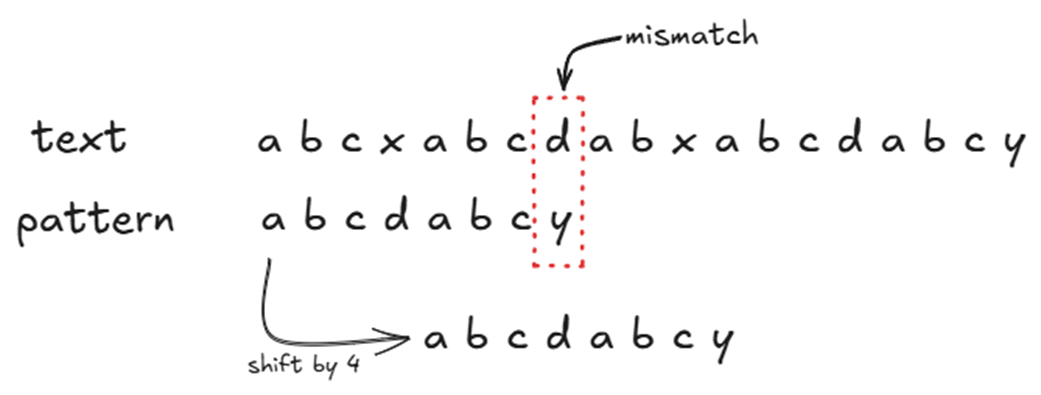
The figure traces the initial mismatch, the lookup for “d,” and the resulting four-position shift. section 6.2
