Rigid-body dynamics models robot links and environmental objects as nondeforming bodies. Joints impose kinematic constraints on their relative motion, while meshes define collision geometry and visual textures improve rendering. section 5.3
A practical simulation model combines:
- Rigid bodies representing robot links and objects. section 5.3
- Joints restricting relative motion between connected bodies. section 5.3
- Meshes supporting collision detection and visual representation. section 5.3
Manipulator simulation
Gazebo can simulate a manipulator in its workcell while a motor controller is validated, then switch to a simpler motor model for faster execution. High-fidelity electromechanical models can also be combined with general-purpose physics simulation. section 5.3
Figure 5.7 Co-simulation integrates high-fidelity electromechanical models, such as Functional Mock-up Units (FMUs) that represent electric motors, with a general-purpose physics engine that simulates the overall robot kinematics and dynamics. [5]
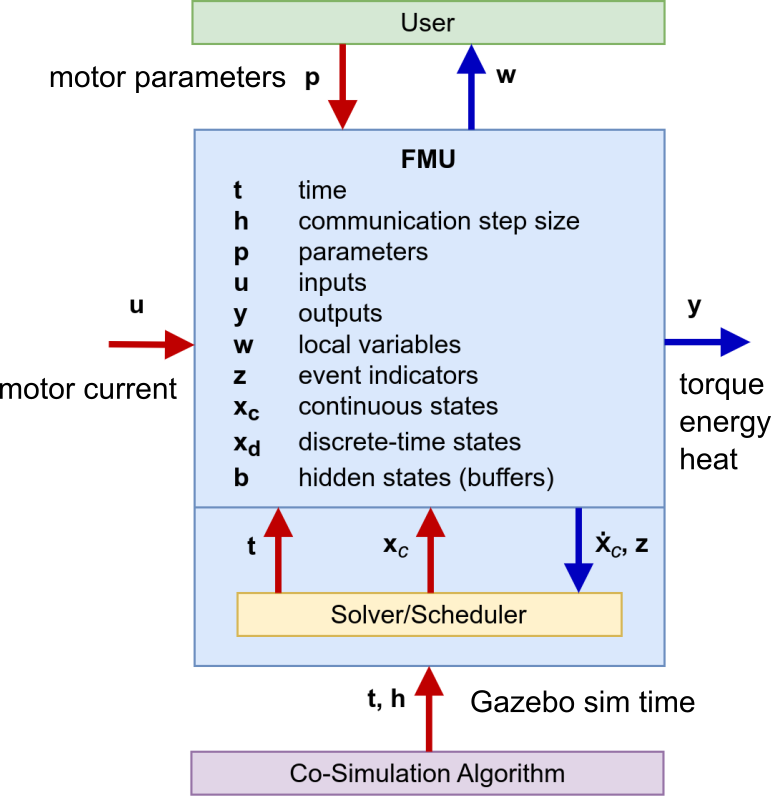
Shows co-simulation linking detailed motor models with general-purpose simulation of robot kinematics and dynamics. section 5.3
