Risk exposure measures an organization’s potential loss or damage from existing vulnerabilities and emerging threats. It reflects vulnerability presence, exploitation likelihood, and effects on critical systems, helping leaders prioritize resources. section 10.2
Interpret risk exposure through current conditions and changing threat information:
- Reassess exposure continuously because new exploitation methods can turn a previously low-risk vulnerability into a critical threat. section 10.2
- Use the risk exposure index (REI) to combine vulnerability counts, exploitation likelihood, and business impact into an overall risk view. section 10.2
- Pair REI with the predictive threat index (PTI), which uses historical attacks, threat intelligence, and real-time monitoring to estimate future incidents. section 10.2
SecureNet’s six-month improvement target
SecureNet Inc. began with an 80% REI, a 60% six-month malware likelihood, 50 malware incidents per month, and a 12-hour response time. It targeted REI below 40%, PTI below 20%, 15 monthly incidents, and four-hour response. After prioritizing highly exposed vulnerabilities and applying predictive analytics, REI fell to 35% after six months. section 10.2.3
Figure 10.1 The left side shows risk exposure and predictive analytics before implementing improvements. The right side shows the situation afterward.
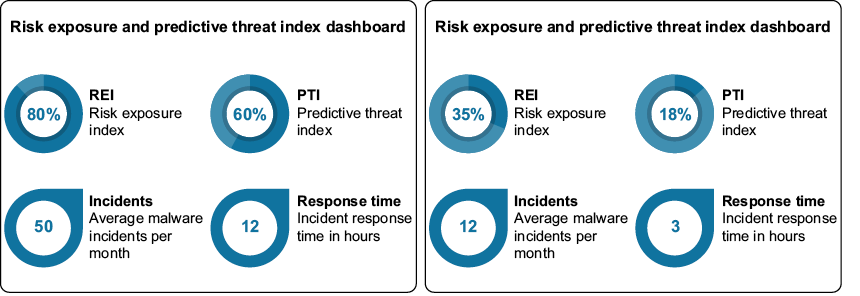
Compare SecureNet’s risk exposure and predictive metrics before and after its improvement program. section 10.2.3
