RLOO (REINFORCE leave one out) is a policy-gradient method for training a language-model policy from rewards on multiple completions of the same prompt. Rather than asking whether a completion is good in absolute terms, it asks whether it scored better than its sibling completions. This relative baseline reduces gradient variance without learning a value function. section 6.2.4 section 6.6
For a prompt s with K sampled completions a₁…aₖ and rewards R(s,a₁)…R(s,aₖ), completion k receives the leave-one-out baseline b(s,aₖ) = (1/(K−1)) Σᵢ≠ₖ R(s,aᵢ). Its advantage is A(s,aₖ) = R(s,aₖ) − b(s,aₖ). Excluding the completion’s own reward makes the baseline independent of the evaluated action, preserving an exactly unbiased gradient estimator. section 6.2.4
Figure 6.3 RLOO architecture. Multiple completions per prompt provide a leave-one-out baseline for advantage estimation without learning a value function.
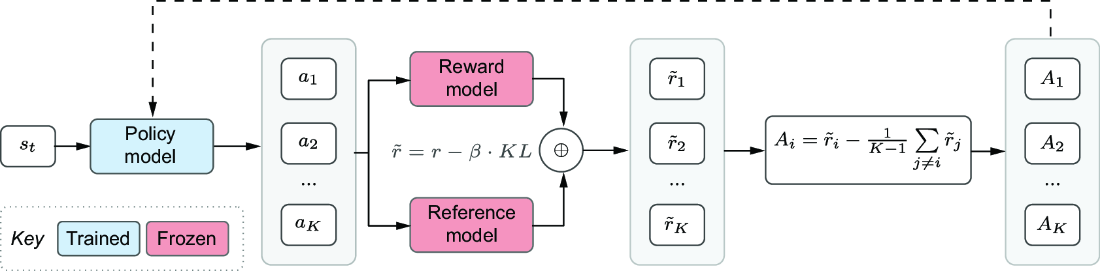
Multiple completions from one prompt supply the comparison set: each completion is rewarded relative to the mean reward of all the others. section 6.2.4
The policy loss applies each sequence-level advantage to the log probabilities of that completion’s tokens. A positive advantage raises the probability of every sampled token; a negative advantage lowers it. Because RLOO has no critic, every token in a completion receives the same final sequence-level signal, unlike PPO’s token-specific value-based advantages. section 6.2.11 section 6.2.4
Vectorized per-prompt advantages
Store total rewards for N prompts with k completions as a flat tensor, reshape it to (k, N), then compute baseline = (rewards.sum(0) − rewards) / (k − 1). Subtracting that baseline yields a (k, N) advantage tensor, which can be flattened to align again with the completions. This implementation ensures every baseline compares only completions answering the same prompt. section 6.3.7
RLOO’s practical trade-offs are:
- It requires multiple trajectories per prompt; a single completion cannot form a leave-one-out baseline. section 6.2.4
- It avoids a learned value network and importance-sampling ratio, making it simpler than PPO but limiting the extra update machinery those components support. section 6.2.11
- It is closely related to group-relative methods: Dr. GRPO’s unnormalized group-mean advantage is equivalent to RLOO up to a constant scaling factor. section 6.2.8
- KL regularization can be folded into RLOO rewards, whereas canonical GRPO applies its KL penalty directly in the loss; PPO-style clipping can also be combined with RLOO advantages. section 6.2.4
Table 6.1 Comparing policy gradient algorithms. IS: Importance Sampling.
| Method | IS granularity | Clipping style | Advantage |
| REINFORCE | None | None | Monte Carlo baseline |
| RLOO | None | None | Leave-one-out |
| PPO | Token | Objective (bilateral) | Learned value function |
| GRPO | Token | Objective (bilateral) | Group-relative |
| GSPO | Sequence | Objective (bilateral) | Group-relative |
| CISPO | Token | Weights (stop-grad) | Group-relative |
Use the comparison table to distinguish RLOO’s leave-one-out advantage and lack of importance sampling from REINFORCE, PPO, GRPO, GSPO, and CISPO. section 6.2.11
