A robot system lifecycle organizes a robot solution from its first purpose statement through deployment, use, and maintenance. It is not a one-way handoff from hardware to software: decisions about the operating environment, robot type, and architecture constrain what sensors, actuators, and software behavior are feasible, while real-world results drive refinement. section 1.3 section 2.2
Start by defining the robot’s objective and its operating environments. Narrow, explicit requirements make a system simpler, more reliable, and more cost-effective. Then choose a robot type—such as a stationary manipulator, mobile robot, or mobile manipulator—and establish an architecture that addresses physical constraints including size, payload, locomotion, ruggedness, and protection from dust or water. section 1.3 section 1.3
A practical lifecycle has these connected phases:
- Conceptual design: define the purpose, environment, robot type, and high-level architecture. section 1.3 section 2.2
- Detailed design and development: select sensors and actuators, define the planning concept, and build and test the system, including simulation. section 1.3 section 2.2
- Commissioning: deploy the robot solution into its intended setting. section 2.2
- Operation and maintenance: use the deployed robot and sustain it over time. section 2.2
After the initial architecture is chosen, sensor selection, actuator selection, and planning-concept definition can proceed in parallel. Sensing and acting software are implemented around the chosen hardware; the planning component then connects sensing to action. Hardware is therefore part of the software engineer’s problem: it determines available inputs and outputs, plus the capabilities and constraints the software must handle. section 1.3 section 1.3
Choosing a mobile robot
A driving robot illustrates how early choices propagate. Its payload, wheel or track design, size, and environmental hardening affect the possible sensor and actuator choices. Those choices shape the sensing and acting components, which in turn bound the planning behavior that can be implemented. Field conditions then expose mismatches and trigger another iteration. section 1.3 section 1.3
Lifecycle work also spans engineering infrastructure. Development can involve IDEs, compilers, debuggers, build systems, CI/CD, CAD/CAE tools, development machines, and simulators. A robot may be one monolithic computer or several embedded systems forming a distributed system, so deployment and maintenance must account for the system boundary as well as individual software components. section 2.2 section 2.2
Figure 1.3 The robot development lifecycle is an iterative process that begins with defining the robot’s purpose and environment. This guides the choice of robot type and architecture, which in turn drives parallel decisions about sensor selection, actuator selection, and the planning concept. With the hardware defined, the sensing and acting software components are implemented, followed by the planning component that ties the system together. Because the real world is messy and unpredictable, continuous iteration across these stages is essential to refine the system.
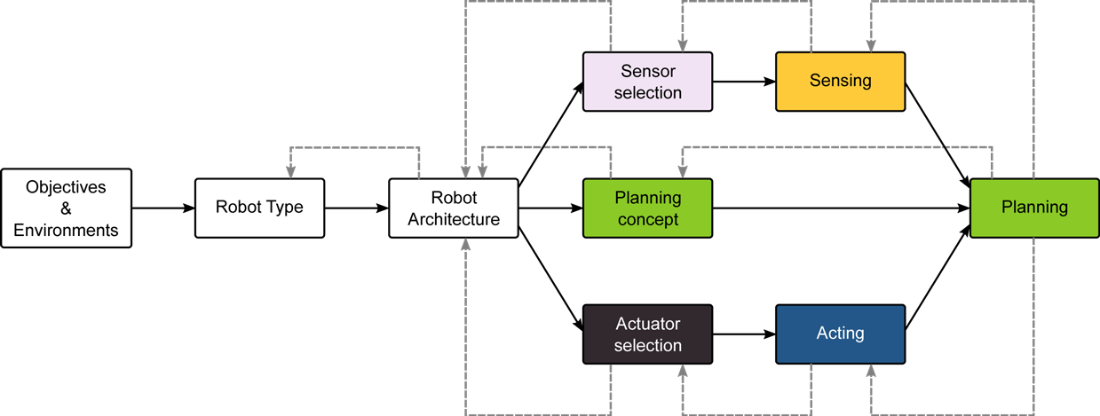
The diagram makes the dependency chain visible: purpose and environment guide type and architecture; hardware choices guide sensing, acting, and planning; iteration feeds experience back into the system. section 1.3