The roofline model estimates a GPU kernel’s achievable performance from its arithmetic intensity—the operations performed per byte moved—and the hardware’s compute and memory limits. A kernel’s position relative to the compute and memory roofs indicates its bottleneck and remaining optimization headroom. section 3.1.5
Read the two limits together:
- The compute roof is a horizontal ceiling set by peak arithmetic throughput. section 3.1.5
- The memory roof rises with arithmetic intensity; its slope is peak memory bandwidth. section 3.1.5
A naive FP32 matrix multiplication
For large K, the naive kernel performs about 0.25 FLOP per byte. On the stated H200 specifications, that places its calculated bandwidth-limited throughput at 1.2 TFLOP/s, versus an FP32 ridge point near 14 FLOP/byte. These are theoretical estimates, not measured results. section 5.5.3
Figure 5.11 The theoretical roofline position of the naive FP32 matmul kernel on an NVIDIA H200 SXM. The 0.25 FLOP/byte arithmetic intensity intersects the listed 4.8 TB/s memory-bandwidth roof at 1.2 TFLOP/s. The FP32 ridge is approximately 14 FLOP/byte. Both positions are calculated from published specifications and are not measured kernel results.
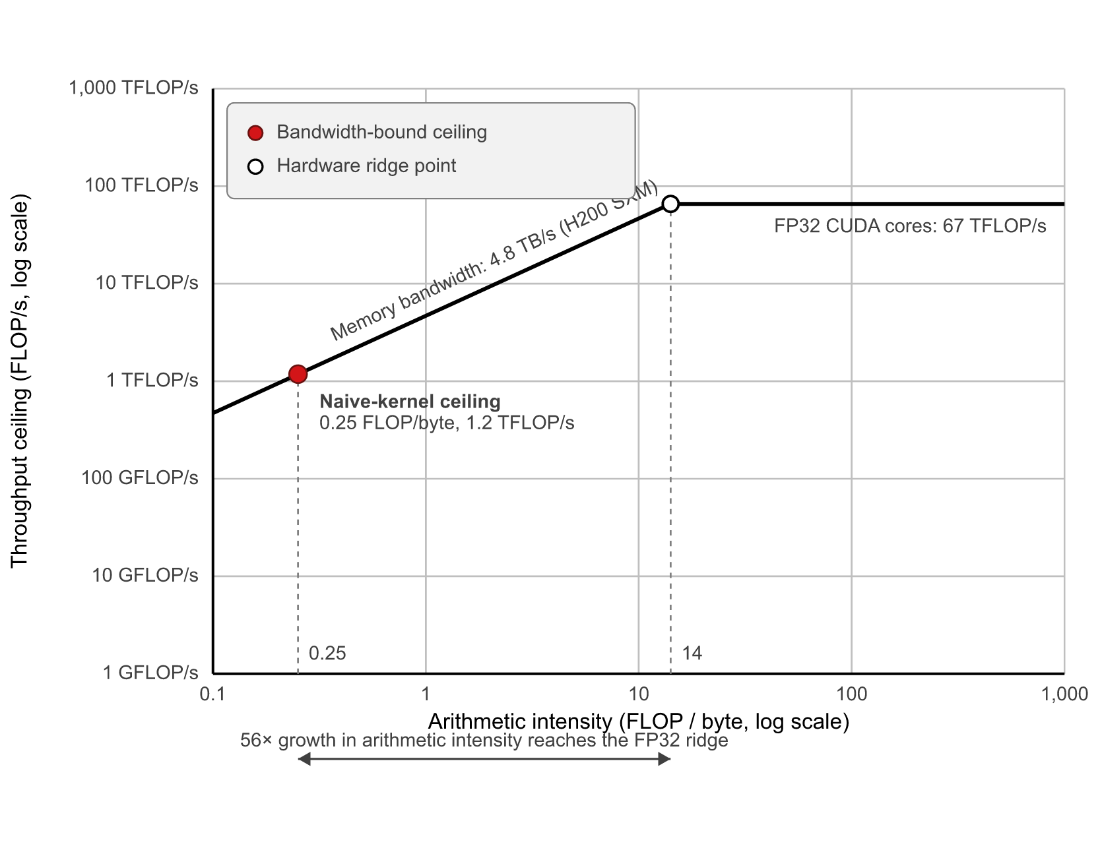
See the calculated roofline position for the naive FP32 matmul and the H200’s stated limits. section 5.5.3
