liveBook · Manning

Root access point

As explained in Acing the CCNA Exam: Volume 2 Advanced Networking and Security

A root access point is a mesh access point that has a connection to the distribution system.

A root access point (RAP) is the access point connected to the distribution system (DS) in a mesh basic service set (MBSS). It provides the wired anchor through which mesh-connected access points can relay traffic between wireless clients and the DS. section 18.3.4

An MBSS uses wireless links between access points when cabling every access point is impractical or expensive. A RAP connects to the DS; a mesh access point (MAP) does not. Two-radio designs can separate client service from mesh forwarding, while single-radio designs perform both jobs with reduced performance. section 18.3.4 section 18.5

Figure 18.18 An MBSS is a mesh of wireless connections between two types of APs, RAPs and MAPs, that allows them to relay data to and from wireless clients.
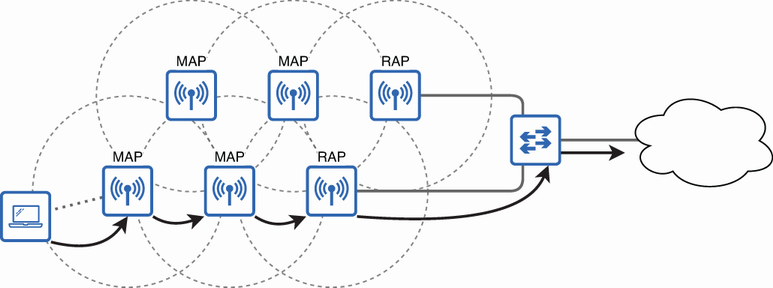
Use the topology figure to visualize RAPs and MAPs forming wireless paths between clients and the distribution system. section 18.3.4

How Acing the CCNA Exam: Volume 2 Advanced Networking and Security covers it

How deep it goes
Explains RAP and MAP roles, mesh relaying, and radio allocation, but does not provide configuration or verification procedures.
Examples
Illustrates a wireless mesh containing RAPs and MAPs, with two-radio and single-radio access-point arrangements.
What you can do after
Evaluate which access point anchors an MBSS to the distribution system and distinguish it from a MAP.
How it connects
Connects mesh basic service sets, distribution systems, mesh access points, wireless clients, and wireless frame relaying.

Related concepts

This explainer was generated by Manning's knowledge graph from the text of Acing the CCNA Exam: Volume 2 Advanced Networking and Security. The section links point to the parts of the book it draws on.