A root of unity is a field element whose positive integer power is 1. An mth root of unity μm satisfies μm^m=1; over the complex numbers, μm=e^(2iπn/m), so raising it to the mth power returns 1. In elliptic-curve pairings, the pairing output is such a field element rather than another curve point. section 15.1 section 15.6
This output change is operationally important: point order is tested by scalar multiplication, mP, reaching the point at infinity, while field-element order is tested by exponentiation, μm^m, reaching 1. A pairing therefore translates elliptic-curve point addition into multiplication in a finite-field extension. section 15.1 section 15.6
For a pairing with points of order m:
- The result lies among elements of order m in the extension field p^k. section 15.1
- Bilinearity gives e_m(aS,bT)=e_m(S,T)^(ab), connecting scalar multiplication of inputs to exponentiation of the output. section 15.6
- Nondegeneracy ensures a pairing involving the point at infinity has value 1. section 15.6
An 11th root in a finite-field extension
Modulo x^2+x+3 over 43, the element 32x+34 becomes 1 when raised to the 11th power. It is therefore an 11th root of unity. In a tiny Weil-pairing test, pairing values for points of order 11 likewise satisfy e_m(P,Q+T)^11=1. section 15.5 section 16.3
The restricted output set also helps test implementations. In a Tate-pairing example over a field with 43^2=1849 values, only 11 values can be 11th roots of unity, so repeated pairing outputs are expected rather than anomalous. section 17.3
Figure 15.3 \(n^{th}\) root of unity for \(n=7\) using complex numbers. Multiply any of these vectors by 7, and the result is 1.
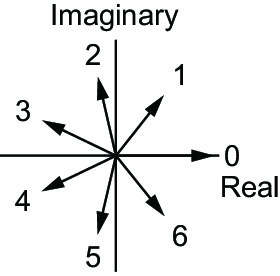
Visualizes the seven complex 7th roots as equally stepped directions around the complex plane, illustrating how the exponent cycles back to 1. section 15.1
