liveBook · Manning

Root span

As explained in Cloud Observability in Action

A root span is the first span representing the start of a distributed trace's request processing.

A root span is the first span created when a request enters an application. It represents the overall execution at the start of a distributed trace. section 8.1.2 section 2.5

Checkout request

In a microservices e-commerce request, the checkout service forms the root span. Child spans represent calls to billing and the third-party payment provider, allowing a waterfall to show where time is spent. section 8.1.1

A root span anchors several tracing relationships:

  • It belongs to the trace containing the request’s end-to-end processing. section 8.1.2
  • It precedes nested child spans created by downstream work. section 2.5
  • It helps connect timing visualizations with service execution and related logs. section 2.5
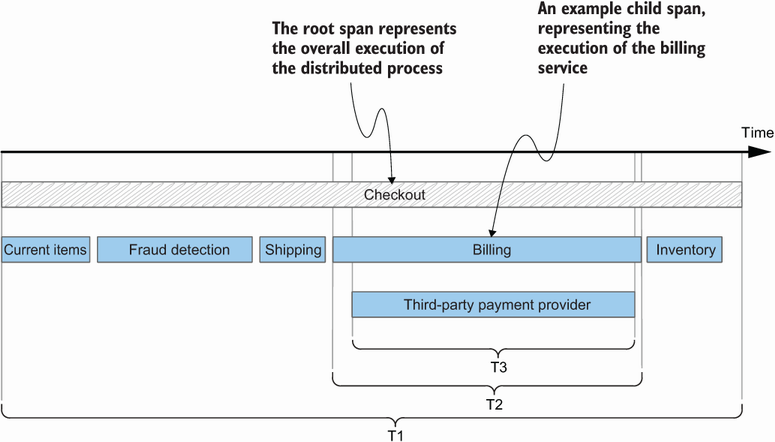
Figure 8.3 A single request path in the app, as a temporal (waterfall) visualization

Use the temporal waterfall to inspect the root span alongside child spans and identify where request time accumulates. section 8.1.1

How Cloud Observability in Action covers it

How deep it goes
Defines the span’s position and role, then illustrates timing through a checkout trace without detailing instrumentation internals.
Examples
Uses a checkout service root span with billing and payment-provider child spans in a microservices e-commerce request.
What it assumes
Assumes basic familiarity with traces and spans while defining the root span within that terminology.
What you can do after
Evaluate distributed request timing by locating the root span and comparing its duration with downstream child spans.
How it connects
Connects root spans with traces, child spans, context propagation, and waterfall visualization.

Related concepts

This explainer was generated by Manning's knowledge graph from the text of Cloud Observability in Action. The section links point to the parts of the book it draws on.