liveBook · Manning

Pairing sweep

As explained in Elliptic Curve Cryptography for Developers

A pairing sweep is a systematic enumeration of parameter values for pairing-friendly curve formulas followed by tests for acceptable prime and size conditions.

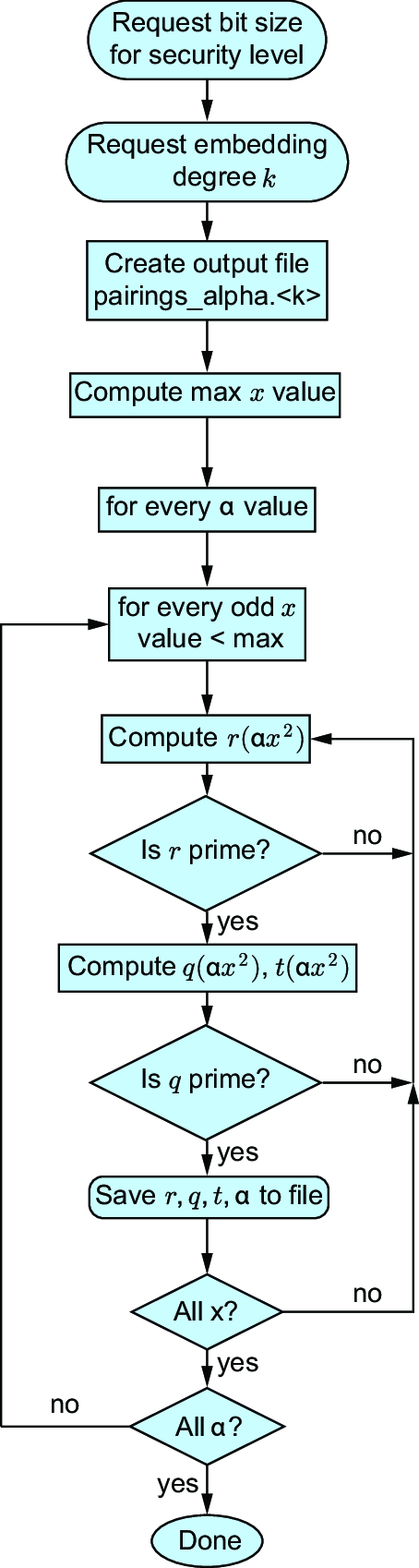
A pairing sweep systematically enumerates discriminants α and odd parameters x, evaluates r(z), q(z), and t(z) with z = αx², then tests prime and size conditions for pairing-friendly curves. section 14.5.1

A practical sweep follows this execution flow:

  • Choose an embedding degree k and a maximum bit size lg2r; estimate the x limit from 2^(lg2r/(2k−2)). section 14.5.1

Command-line sweep

Running pairing_sweep_alpha 260 with k = 13 processes α values from 7 onward and reports 182 r primes. A result can contain 62-bit r, 76-bit q, ρ = 1.225806, and t = −34.

Figure 14.3 Program that sweeps over \(α\) to find pairing-friendly curves
figure

Use the flow chart to inspect the sweep’s main control path from parameter selection through candidate testing. section 14.5.1

How Elliptic Curve Cryptography for Developers covers it

How deep it goes
Descends through formulas, GMP routines, loop bounds, primality checks, size cutoffs, and algorithm selection.
Examples
Demonstrates C/GMP routines, a k = 13 command-line run, and candidate outputs with r, q, t, and ρ.
What it assumes
Assumes the formulas for r(z), q(z), and t(z), while defining z, sweep bounds, supported k values, and loop behavior.
What you can do after
Builds a parameter-search program that evaluates candidate formulas and filters results by probable primality and bit size.
How it connects
Connects embedding degree, cyclotomic polynomials, pairing-friendly curves, probable-prime testing, and ρ.

Related concepts

This explainer was generated by Manning's knowledge graph from the text of Elliptic Curve Cryptography for Developers. The section links point to the parts of the book it draws on.