A Roth conversion transfers assets from a traditional IRA into a Roth IRA, usually creating taxable income in the conversion year. It addresses retirement decumulation by coordinating account withdrawals, tax brackets, and account longevity. section 9.2.6 section 1.2.2
Comparing withdrawal strategies
A modeled retirement portfolio lasts 53.2 years with Roth conversions, compared with 40.0 years using IRA-first withdrawals, 48.7 years using taxable-first withdrawals, and 44.5 years filling the tax bracket. The result depends strongly on assumptions about annual tax drag: reducing the drag from 1% to 0.5% narrows the advantage of tax-advantaged sequencing. section 9.2.6
Apply the strategy by weighing these mechanics and trade-offs:
- Convert any amount from a traditional IRA, regardless of income, and pay the resulting taxes in the conversion year. section 9.2.6
- Keep each conversion in the Roth IRA for five years; withdrawing converted principal earlier than five years and before age 59½ generally triggers a 10% penalty. section 9.2.6
- Use conversions to deplete less tax-efficient accounts first while keeping tax brackets more stable over time. section 9.2.6
- Reassess the strategy for inheritance: an owner in a lower tax bracket may convert before death, while a higher-bracket owner may preserve the traditional IRA for beneficiaries. section 9.3.2
Table 9.5 Comparison including the Roth conversion strategy
| Strategy | Number of years money lasts |
| IRA first, then taxable | 40.0 |
| Taxable first, then IRA | 48.7 |
| Fill 12% bracket first | 44.5 |
| Roth conversion | 53.2 |
Compare modeled portfolio longevity across IRA-first, taxable-first, tax-bracket-filling, and Roth-conversion strategies. section 9.2.6
Figure 9.5 Total assets with the Roth conversion strategy
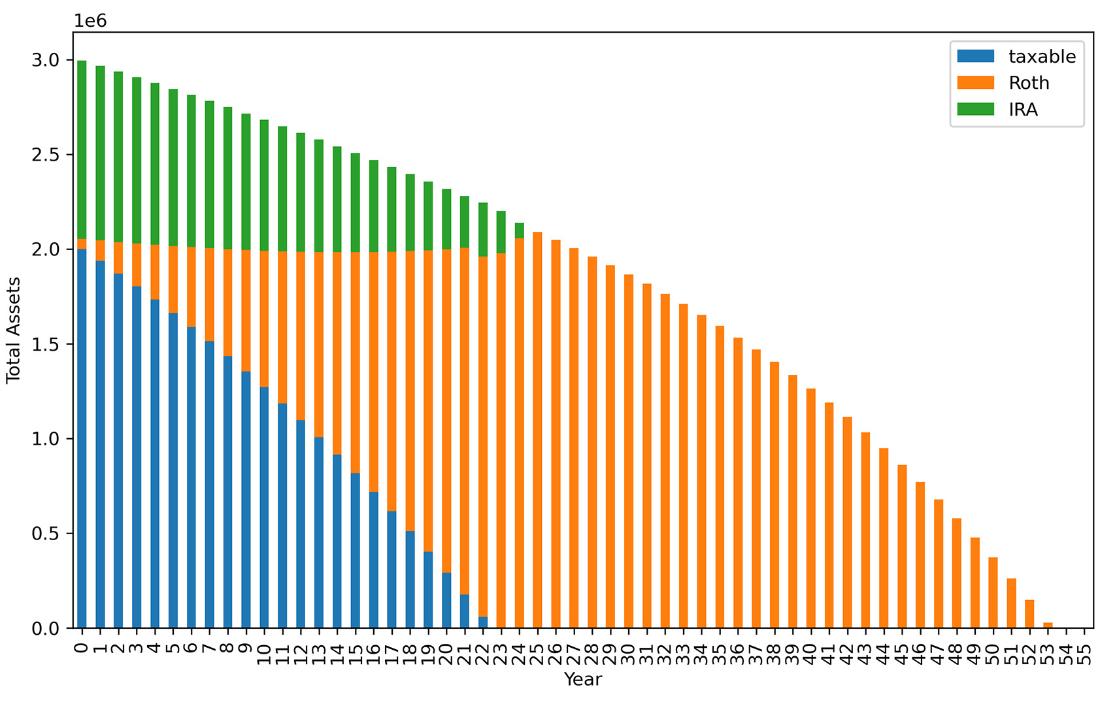
Trace how IRA, taxable, and Roth account balances evolve while the conversion strategy operates. section 9.2.6
