A route manifest is the file or declaration that enumerates a system’s exposed entry points: URLs, CLI subcommands, library exports, or typed operations. Find it before reading handlers; it turns a scattered interface into a map of the system’s surface area. section 8.2
Search framework conventions first:
- Rails: config/routes.rb; Django: urls.py files combined through urlpatterns and include(). section 8.2
- Express or Fastify: routes.ts or router.ts; Next.js: pages/api or app route files; tRPC: _router.ts. section 8.2
- GraphQL or gRPC: schema.graphql or .proto; Go web routes and CLIs: router.go or cmd files. section 8.2
A typed feature map
A tRPC holidays router composes procedures such as getSupportedCountries and getUserSettings, while schemas define inputs and handlers perform the work. The manifest reveals the feature’s entry points before implementation details. section 8.2
Figure 8.4 Four routing styles, and the effort required to map the full API for each. Filesystem routes are visible with ls; an aggregator file lists all routes in one place; decorator-scattered routes require scanning every handler; and a schema file defines the entire surface, one typed line per operation.
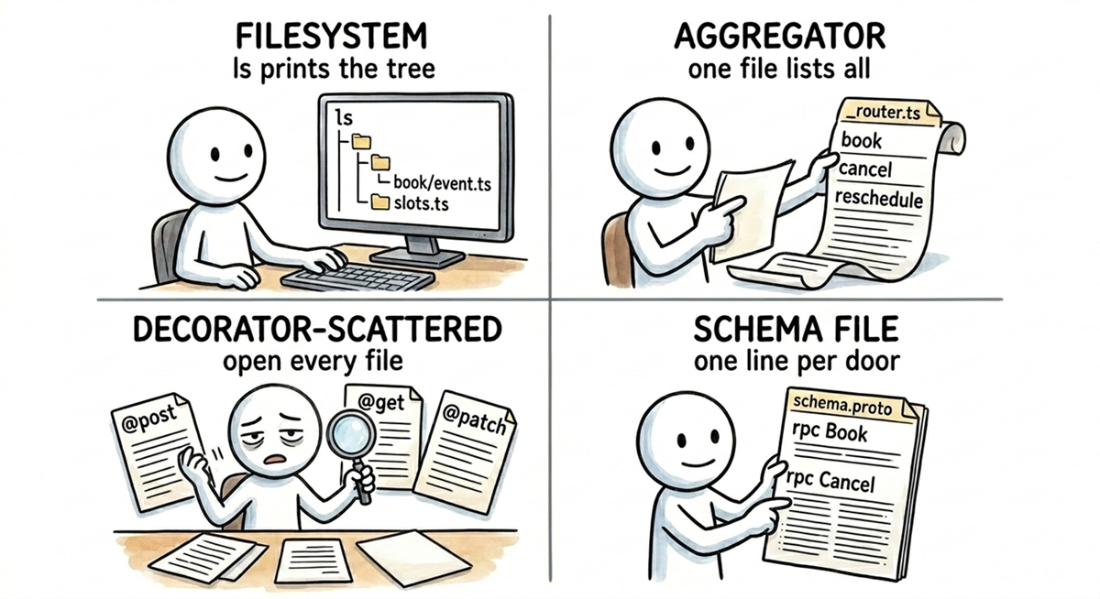
Compare filesystem routes, aggregator files, decorator-scattered routes, and schema-defined interfaces by the effort required to map them. section 8.2
