Routing table population is the process of selecting which learned or configured routes a router enters into its routing table. A route absent from the table cannot forward packets. Do not confuse it with packet forwarding, which selects the best matching route for a particular packet. section 17.3
When multiple routes lead to the same destination, the router inserts only the best route, comparing administrative distance and metric. Different prefix lengths represent different destinations during table population, even when the networks overlap. section 17.3 section 17.3.3
Overlapping routes
R1 learns 203.0.113.0/24 through static routing, /25 through RIP, /26 through EIGRP, and /27 through OSPF. It inserts all four routes because their prefix lengths identify different destinations. IOS output shows each route with its source, administrative distance, and metric. section 17.3.3
Figure 17.15 The four routes in the example overlap. 203.0.113.0/24 includes 203.0.113.0–.255, 203.0.113.0/25 includes 203.0.113.0–.127, 203.0.113.0/26 includes 203.0.113.0–.63, and 203.0.113.0/27 includes 203.0.113.0–.31. However, IOS considers them to be routes to different destinations and will insert all four routes into the routing table.
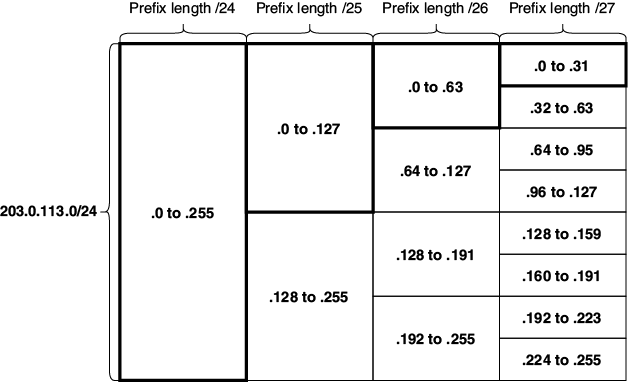
Use the overlap diagram to compare the address ranges covered by /24, /25, /26, and /27 and see why IOS treats them as separate destinations. section 17.3.3
