A rule is a prescribed condition or policy that determines permitted behavior or outcomes. In collaborative modeling, rules make stakeholder expectations explicit and provide a basis for exploring acceptance criteria through concrete examples. section 2.3.3
Use rules as the blue layer in an Example Mapping session:
- Write the user story or use case on a yellow sticky. section 2.3.3
- Record known rules on blue stickies beneath it. section 2.3.3
- Add specific examples on green stickies, then discuss what-if cases to reveal missing or revised rules. section 2.3.3
Seat reservations
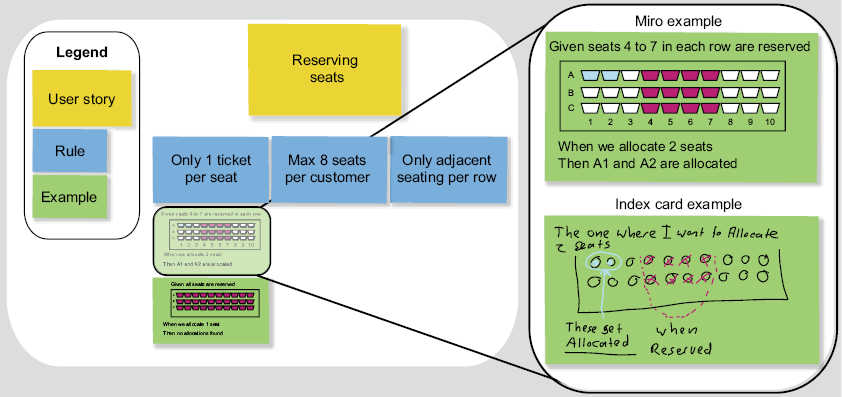
For a cinema reservation, “Only 1 ticket per seat” becomes a rule with concrete examples. Discussing adjacent reservations with an empty chair between them can reveal a further “No Orphan Seats” rule and clarify the desired outcome. section 2.3.3
Figure 2.19 An example of how to start an Example Mapping. With a user story and the rules, we explore the first concrete example of the rule. On the right side, you can see how to do it either using a virtual board such as Miro or using index cards in a physical setting and drawing with a dry-erase marker on it. From here, we can discuss and find new examples.
Compare a virtual board such as Miro with index cards and drawings for arranging rules and examples during collaborative discovery. section 2.3.3

