Runge phenomenon is the growth of uncontrolled oscillations in a high-degree interpolating polynomial, especially near the ends of its interval. Adding data points raises the polynomial degree and can create more bumps, so the curve may move far from the values suggested by neighboring points. section 6.3.2
The mechanism is straightforward:
- An interpolating polynomial through N points has degree N−1. section 6.3.2
- Its derivative has degree N−2 and may therefore have up to N−2 roots, producing many possible extrema or bumps. section 6.3.2
- As more points are added, oscillations commonly intensify, making a single large polynomial impractical for large data sets. section 6.3.2 section 7.2.1
A long curve versus smaller pieces
A parametric polynomial curve can gain extra degrees to pass through more points or constrain endpoint curvature, but eventually becomes too large and unpredictable. Splitting the target into smaller polynomial curves and joining them while matching tangent vectors avoids that unpredictability; splines provide the corresponding approach for large data sets. section 7.2.1
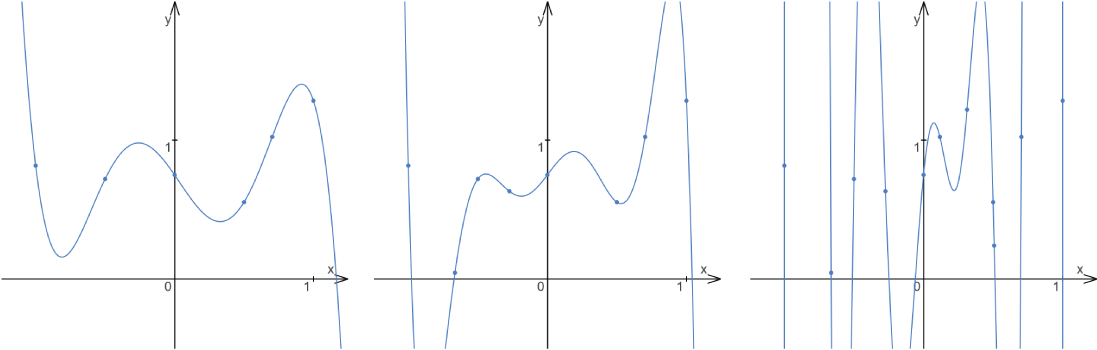
Use the figure to inspect how polynomial oscillations usually worsen as the data set gains points. section 7.2.1
